

AI-900-KR 문제 131
문장을 올바르게 완성하는 답을 선택하세요.

정답:

Explanation:

According to the Microsoft Azure AI Fundamentals (AI-900) official study guide and Microsoft Learn module "Identify features of common machine learning types", regression is a supervised machine learning technique used to predict continuous numerical values based on one or more input features. In this scenario, the task is to predict a vehicle's miles per gallon (MPG)-a continuous numeric value-based on several measurable factors such as weight, engine power, and other specifications.
Regression models learn the mathematical relationship between input variables (independent features) and a numeric target variable (dependent outcome). Common regression algorithms include linear regression, decision tree regression, and support vector regression. In the example, the model would analyze historical data of vehicles and learn patterns that map characteristics (like engine size, horsepower, and weight) to fuel efficiency. Once trained, it can predict the MPG for a new vehicle configuration.
The other options describe different problem types:
* Classification predicts discrete categories (for example, whether a car is "fuel efficient" or "not fuel efficient"), not continuous values.
* Clustering is an unsupervised learning method that groups data points based on similarities without predefined labels, not predictive modeling.
* Anomaly detection identifies data points that significantly deviate from normal patterns, such as detecting engine sensor failures or fraudulent transactions.
Since predicting MPG involves estimating a numeric value within a continuous range, regression is the most appropriate model type.
In summary, per AI-900 training content, regression models are used when the output variable is numeric, classification for categorical outputs, and clustering for pattern discovery. Therefore, predicting miles per gallon based on vehicle features is a textbook example of a regression problem in Azure Machine Learning.
AI-900-KR 문제 132
QnA Maker 지식 기반에서 응답을 제공하는 웹 채팅 봇이 있습니다.
봇이 사용자 피드백을 활용하여 시간이 지남에 따라 응답의 관련성을 개선하도록 해야 합니다.
무엇을 사용해야 하나요?
봇이 사용자 피드백을 활용하여 시간이 지남에 따라 응답의 관련성을 개선하도록 해야 합니다.
무엇을 사용해야 하나요?
정답: D
According to the Microsoft Azure AI Fundamentals (AI-900) study guide and the official Microsoft Learn module "Describe features of common AI workloads", QnA Maker (now part of Azure AI Language services) allows developers to build, train, and publish a knowledge base that provides natural-language answers to user queries. A key capability of this service is active learning, which enables the knowledge base to automatically suggest improvements by analyzing user feedback and usage patterns.
Active learning is an iterative process in which the service observes real user interactions and identifies ambiguous questions or pairs of similar questions that produce uncertain or multiple answers. The system then recommends updates or refinements to the knowledge base to improve the accuracy and relevance of responses. This feedback loop helps ensure that over time, the chatbot's responses align more closely with actual user expectations and language variations.
In contrast:
* A. Key phrase extraction identifies main ideas in text and is used in content summarization, not in response optimization.
* B. Sentiment analysis detects emotional tone (positive, negative, neutral), but it doesn't refine QnA responses.
* C. Business logic defines operational rules in an application, not machine learning-driven feedback.
The AI-900 guide specifically emphasizes that QnA Maker supports active learning to improve the quality of answers based on end-user feedback, making this the verified and official Microsoft answer.
Reference (from Microsoft Learn AI-900 content):
"Active learning uses feedback from end users to automatically suggest improvements to a knowledge base, helping improve the accuracy of answers over time."
Active learning is an iterative process in which the service observes real user interactions and identifies ambiguous questions or pairs of similar questions that produce uncertain or multiple answers. The system then recommends updates or refinements to the knowledge base to improve the accuracy and relevance of responses. This feedback loop helps ensure that over time, the chatbot's responses align more closely with actual user expectations and language variations.
In contrast:
* A. Key phrase extraction identifies main ideas in text and is used in content summarization, not in response optimization.
* B. Sentiment analysis detects emotional tone (positive, negative, neutral), but it doesn't refine QnA responses.
* C. Business logic defines operational rules in an application, not machine learning-driven feedback.
The AI-900 guide specifically emphasizes that QnA Maker supports active learning to improve the quality of answers based on end-user feedback, making this the verified and official Microsoft answer.
Reference (from Microsoft Learn AI-900 content):
"Active learning uses feedback from end users to automatically suggest improvements to a knowledge base, helping improve the accuracy of answers over time."
AI-900-KR 문제 133
경주 중인 주자들의 사진을 처리하고 있습니다.
사진 속 선수를 식별하려면 선수 셔츠에 적힌 번호를 읽어야 합니다. 어떤 유형의 컴퓨터 비전을 사용해야 할까요?
사진 속 선수를 식별하려면 선수 셔츠에 적힌 번호를 읽어야 합니다. 어떤 유형의 컴퓨터 비전을 사용해야 할까요?
정답: B
The correct answer is B. Optical Character Recognition (OCR).
Optical Character Recognition (OCR) is a feature of Azure AI Vision that converts printed or handwritten text within images into machine-readable text. In this scenario, the goal is to read runner numbers on shirts from race photos. OCR can identify and extract these numbers, allowing them to be associated with specific participants.
Option analysis:
* A. Image classification: Categorizes entire images (e.g., "runner," "crowd"), not text.
* B. Optical Character Recognition (OCR) - # Correct. Extracts alphanumeric text from images.
* C. Object detection: Identifies and locates objects (e.g., shoes, cars) but doesn't read text.
* D. Facial recognition: Identifies individuals by matching facial features to known identities, not by reading numbers.
Therefore, to read and extract runner numbers from photos, the correct computer vision technique is Optical Character Recognition (OCR).
Optical Character Recognition (OCR) is a feature of Azure AI Vision that converts printed or handwritten text within images into machine-readable text. In this scenario, the goal is to read runner numbers on shirts from race photos. OCR can identify and extract these numbers, allowing them to be associated with specific participants.
Option analysis:
* A. Image classification: Categorizes entire images (e.g., "runner," "crowd"), not text.
* B. Optical Character Recognition (OCR) - # Correct. Extracts alphanumeric text from images.
* C. Object detection: Identifies and locates objects (e.g., shoes, cars) but doesn't read text.
* D. Facial recognition: Identifies individuals by matching facial features to known identities, not by reading numbers.
Therefore, to read and extract runner numbers from photos, the correct computer vision technique is Optical Character Recognition (OCR).
AI-900-KR 문제 134
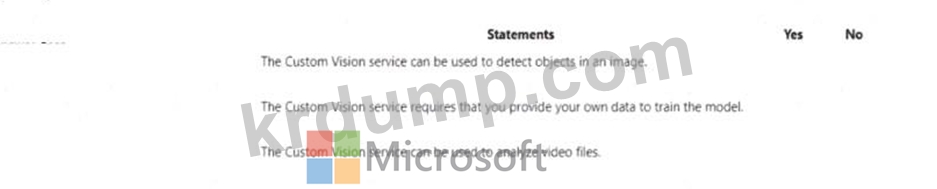
다음 각 문장에 대해, 문장이 사실이라면 '예'를 선택하세요. 그렇지 않으면 '아니요'를 선택하세요.
참고: 정답 하나당 1점입니다.
참고: 정답 하나당 1점입니다.
정답:

Explanation:
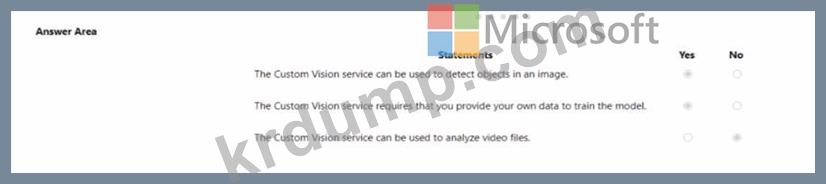
According to the Microsoft Azure AI Fundamentals (AI-900) official study guide and Microsoft Learn module "Identify features of Computer Vision workloads on Azure", the Custom Vision service is a part of Azure Cognitive Services that allows users to build, train, and deploy custom image classification and object detection models. It is primarily designed for still-image analysis, not video processing.
* "The Custom Vision service can be used to detect objects in an image." - Yes.This is correct. The Custom Vision service supports two major model types: classification (categorizing entire images) and object detection (identifying and locating multiple objects within a single image). In object detection mode, the model outputs both the object's category and its position in the image using bounding boxes.
This capability is emphasized in the AI-900 curriculum as an example of applying computer vision to real-world scenarios, such as identifying products on shelves or detecting equipment parts in manufacturing.
* "The Custom Vision service requires that you provide your own data to train the model." - Yes.This statement is also true. Unlike prebuilt computer vision models, Custom Vision is a trainable model that requires users to upload their own labeled images to create a domain-specific AI model. The model's accuracy depends on the quality and quantity of this user-provided data. The AI-900 study materials explain that Custom Vision is used when prebuilt models do not meet specific needs, enabling businesses to train models tailored to unique image sets.
* "The Custom Vision service can be used to analyze video files." - No.This is incorrect. Custom Vision is limited to image-based analysis. To analyze video content (detecting objects or motion in moving frames), Azure provides Video Indexer, which is a separate service designed for extracting insights from video files, including speech, objects, faces, and emotions.
AI-900-KR 문제 135
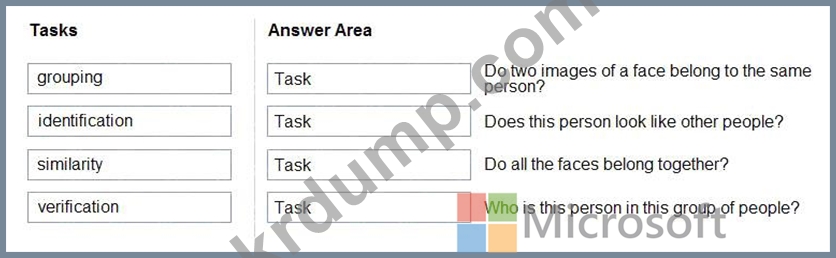
얼굴 인식 과제를 적절한 질문에 연결하세요.
답변하려면 왼쪽 열에서 해당 작업을 오른쪽 질문으로 끌어다 놓으세요. 각 작업은 한 번, 여러 번 또는 전혀 사용하지 않을 수 있습니다.
참고: 정답 하나당 1점입니다.
답변하려면 왼쪽 열에서 해당 작업을 오른쪽 질문으로 끌어다 놓으세요. 각 작업은 한 번, 여러 번 또는 전혀 사용하지 않을 수 있습니다.
참고: 정답 하나당 1점입니다.
정답:
Explanation:
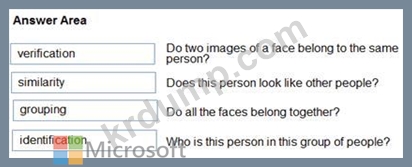
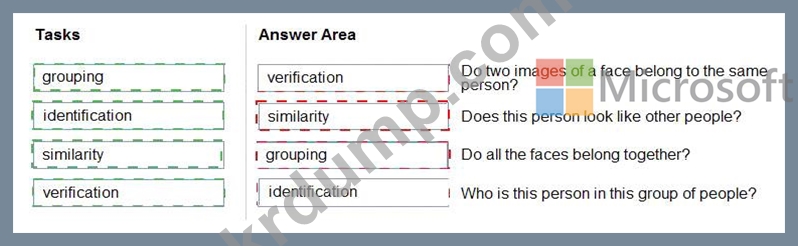
The correct matches are based on the Microsoft Azure AI Fundamentals (AI-900) Official Study Guide and the Microsoft Learn module "Explore computer vision in Microsoft Azure." These materials explain that facial recognition tasks can be categorized into four major operations: verification, identification, similarity, and grouping. Each task serves a distinct purpose in facial recognition scenarios.
* Verification - "Do two images of a face belong to the same person?"The verification task determines whether two facial images represent the same individual. Azure Face API compares the facial features and returns a confidence score indicating the likelihood that the two faces belong to the same person.
* Similarity - "Does this person look like other people?"The similarity task compares a face against a collection of faces to find visually similar individuals. It does not confirm identity but measures how closely two or more faces resemble each other.
* Grouping - "Do all the faces belong together?"Grouping organizes a set of unknown faces into clusters based on similar facial features. This is used when identities are not known beforehand, helping discover potential duplicates or visually similar clusters within an image dataset.
* Identification - "Who is this person in this group of people?"The identification task is used when the system tries to determine who a specific person is by comparing their face against a known collection (face database or gallery). It returns the identity that best matches the input face.
According to Microsoft's AI-900 training, these tasks form the basis of Azure Face API's capabilities. Each helps solve a different type of facial recognition problem-from matching pairs to discovering unknown identities-making them essential components of responsible AI-based vision systems.
- 다른 버전
- 2020Microsoft.AI-900-KR.v2026-05-11.q134
- 1501Microsoft.AI-900-KR.v2026-03-02.q135
- 1922Microsoft.AI-900-KR.v2026-02-07.q121
- 4334Microsoft.AI-900-KR.v2026-01-05.q136
- 1704Microsoft.AI-900-KR.v2026-01-01.q158
- 최근 업로드
- 1341Salesforce.AP-223.v2026-09-01.q94
- 981Splunk.SPLK-5001.v2026-09-01.q60
- 1110Cisco.300-540.v2026-09-01.q62
- 2958Microsoft.MS-102-KR.v2026-09-01.q239
- 1483Microsoft.AI-900-KR.v2026-09-01.q162
- 4209Microsoft.AZ-104-KR.v2026-08-31.q361
- 1796Microsoft.PL-400-KR.v2026-08-31.q166
- 2406USGBC.LEED-Green-Associate-KR.v2026-08-31.q214
- 148HP.HPE0-V27-KR.v2026-08-31.q76
- 131Microsoft.DP-700-KR.v2026-08-31.q62
[×]
PDF 파일 다운로드
메일 주소를 입력하시고 다운로드 하세요. Microsoft.AI-900-KR.v2026-09-01.q162 모의시험 시험자료를 다운 받으세요.