

AI-900-KR 문제 121
문장을 올바르게 완성하는 답을 선택하세요.

정답:

Explanation:

According to the Microsoft Azure AI Fundamentals (AI-900) official study materials and Microsoft Learn module "Describe features of common AI workloads," an anomaly detection workload is designed to identify data points or patterns that deviate significantly from what is expected or normal. These anomalies often indicate irregularities, faults, or potential issues that require attention.
In this scenario, the AI system monitors temperature data from a large machine. Normally, the machine operates within a predictable temperature range. When the AI detects sudden or unexpected temperature spikes or drops - behavior that does not match the historical pattern - it flags these occurrences as anomalies. This type of workload is fundamental in predictive maintenance and industrial monitoring, where it helps detect equipment failures, safety hazards, or energy inefficiencies before they escalate.
Microsoft's AI-900 curriculum emphasizes that anomaly detection workloads are often used in:
* Industrial IoT systems (detecting abnormal sensor readings or machine behavior)
* Finance (fraud detection or unusual transaction monitoring)
* Cybersecurity (detecting irregular network traffic or access patterns)
* Operations (identifying abnormal variations in production data)
The Azure service used for this purpose is Azure Anomaly Detector, part of Azure Cognitive Services, which uses advanced statistical and machine learning models to automatically detect outliers in time-series data such as temperature, pressure, or transaction logs.
By comparison:
* Computer vision handles image or video analysis.
* Knowledge mining extracts insights from large document collections.
* Natural Language Processing (NLP) interprets human language.
Thus, based on the official Microsoft AI-900 study guide and Microsoft Learn, the correct and verified answer is An anomaly detection workload, since detecting unusual temperature fluctuations precisely fits this AI workload type.
AI-900-KR 문제 122
Azure Machine Learning을 사용하여 학습된 모델의 여러 버전을 추적해야 합니다. 어떻게 해야 할까요?
정답: C
According to the Microsoft Azure AI Fundamentals (AI-900) Official Study Guide and the Microsoft Learn module "Explore Azure Machine Learning," registering a model is the correct way to track multiple versions of models in Azure Machine Learning.
When you train models in Azure Machine Learning, each trained version can be registered in the workspace's Model Registry. Registration stores the model's metadata, including version, training environment, parameters, and lineage. Each registration automatically increments the version number, enabling you to manage, deploy, and compare multiple model iterations efficiently.
The other options are incorrect:
* A. Provision an inference cluster - Used for model deployment, not version tracking.
* B. Explain the model - Provides interpretability but does not track versions.
* D. Register the training data - Registers data assets, not models.
When you train models in Azure Machine Learning, each trained version can be registered in the workspace's Model Registry. Registration stores the model's metadata, including version, training environment, parameters, and lineage. Each registration automatically increments the version number, enabling you to manage, deploy, and compare multiple model iterations efficiently.
The other options are incorrect:
* A. Provision an inference cluster - Used for model deployment, not version tracking.
* B. Explain the model - Provides interpretability but does not track versions.
* D. Register the training data - Registers data assets, not models.
AI-900-KR 문제 123
Microsoft의 책임 있는 AI를 위한 세 가지 지침 원칙은 무엇인가요? 각 정답은 완전한 해결책을 제시합니다.
참고: 정답 하나당 1점입니다.
참고: 정답 하나당 1점입니다.
정답: C,D,F
According to the Microsoft Azure AI Fundamentals (AI-900) official study guide and the Microsoft Learn module "Describe features of common AI workloads and considerations", Microsoft has defined six guiding principles for responsible AI. These principles are intended to ensure that AI systems are developed and deployed in ways that are ethical, transparent, and beneficial to all. The six principles are: Fairness, Reliability and Safety, Privacy and Security, Inclusiveness, Transparency, and Accountability.
Let's break down the three correct options:
* Fairness - Microsoft emphasizes that AI systems should treat all individuals fairly and avoid discrimination against people based on gender, race, age, or other characteristics. Fairness ensures that outcomes and decisions from AI systems are equitable across diverse user groups. In the AI-900 learning materials, fairness is explained as a foundational value that ensures algorithms and models do not introduce or amplify societal bias.
* Reliability and Safety - This principle ensures that AI systems function as intended under all expected conditions and that they can handle unexpected inputs safely. Microsoft states that AI should be tested rigorously and validated for reliability before deployment. AI systems must perform consistently and avoid causing harm due to errors or failures.
* Inclusiveness - Inclusiveness focuses on empowering everyone and engaging people of all backgrounds. Microsoft's responsible AI guidance stresses designing AI systems that understand and respect cultural, linguistic, and ability differences to make technology accessible and beneficial to all users.
Options A (knowledgeability), B (decisiveness), and E (opinionatedness) are not part of Microsoft's Responsible AI principles. These terms do not appear in any Microsoft Learn AI-900 curriculum or official responsible AI documentation.
Thus, based on the verified AI-900 study content and Microsoft's Responsible AI framework, the correct answer is C. Inclusiveness, D. Fairness, and F. Reliability and Safety.
Let's break down the three correct options:
* Fairness - Microsoft emphasizes that AI systems should treat all individuals fairly and avoid discrimination against people based on gender, race, age, or other characteristics. Fairness ensures that outcomes and decisions from AI systems are equitable across diverse user groups. In the AI-900 learning materials, fairness is explained as a foundational value that ensures algorithms and models do not introduce or amplify societal bias.
* Reliability and Safety - This principle ensures that AI systems function as intended under all expected conditions and that they can handle unexpected inputs safely. Microsoft states that AI should be tested rigorously and validated for reliability before deployment. AI systems must perform consistently and avoid causing harm due to errors or failures.
* Inclusiveness - Inclusiveness focuses on empowering everyone and engaging people of all backgrounds. Microsoft's responsible AI guidance stresses designing AI systems that understand and respect cultural, linguistic, and ability differences to make technology accessible and beneficial to all users.
Options A (knowledgeability), B (decisiveness), and E (opinionatedness) are not part of Microsoft's Responsible AI principles. These terms do not appear in any Microsoft Learn AI-900 curriculum or official responsible AI documentation.
Thus, based on the verified AI-900 study content and Microsoft's Responsible AI framework, the correct answer is C. Inclusiveness, D. Fairness, and F. Reliability and Safety.
AI-900-KR 문제 124
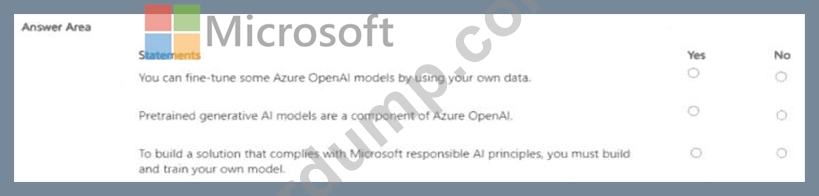
다음 각 문장에 대해, 문장이 사실이라면 '예'를 선택하세요. 그렇지 않으면 '아니요'를 선택하세요.
참고: 정답 하나당 1점입니다.
참고: 정답 하나당 1점입니다.
정답:
Explanation:
Full Detailed Explanation (250-300 words):
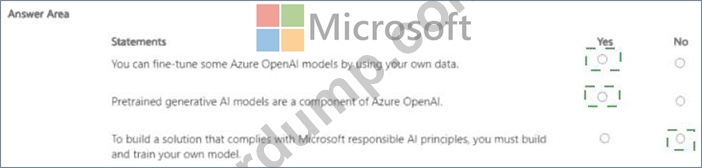
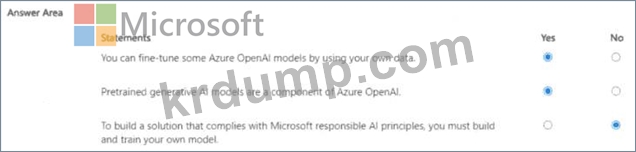
* "You can fine-tune some Azure OpenAI models by using your own data." - YESThis statement is true.
Azure OpenAI allows customers to fine-tune certain models like GPT-3, GPT-3.5, and some embedding models with their own data. Fine-tuning customizes a model to perform better on specific tasks or match a company's domain terminology, tone, or context. According to Microsoft Learn's AI-
900 and Azure OpenAI documentation, fine-tuning is supported for approved use cases while maintaining Microsoft's Responsible AI oversight and compliance process.
* "Pretrained generative AI models are a component of Azure OpenAI." - YESThis statement is also true. Azure OpenAI provides access to pretrained large language and generative AI models such as GPT-3.5, GPT-4, Codex, and DALL E. These models are pretrained on vast datasets and made available via APIs, allowing developers to generate text, code, and images without needing to train their own models. This is a core feature of Azure OpenAI's service offering.
* "To build a solution that complies with Microsoft responsible AI principles, you must build and train your own model." - NOThis statement is false. Compliance with Microsoft Responsible AI principles (Fairness, Reliability & Safety, Privacy & Security, Inclusiveness, Transparency, Accountability) does not require building custom models. Prebuilt Azure AI and OpenAI services already align with Responsible AI standards. Developers simply need to use these services responsibly, applying governance and ethical design practices.
AI-900-KR 문제 125
다음 각 문장에 대해, 문장이 사실이라면 '예'를 선택하세요. 그렇지 않으면 '아니요'를 선택하세요.
참고: 정답 하나당 1점입니다.

참고: 정답 하나당 1점입니다.
정답:

Explanation:

This question assesses knowledge of the Azure Cognitive Services Speech and Text Analytics capabilities, as described in the Microsoft Azure AI Fundamentals (AI-900) official study guide and Microsoft Learn modules "Explore natural language processing" and "Explore speech capabilities." These services are part of Azure Cognitive Services, which provide prebuilt AI capabilities for speech, language, and text understanding.
* You can use the Speech service to transcribe a call to text # YesThe Speech-to-Text feature in the Azure Speech service automatically converts spoken words into written text. Microsoft Learn explains:
"The Speech-to-Text capability enables applications to transcribe spoken audio to text in real time or from recorded files." This makes it ideal for call transcription, voice assistants, and meeting captioning.
* You can use the Text Analytics service to extract key entities from a call transcript # YesOnce a call has been transcribed into text, the Text Analytics service (part of Azure Cognitive Services for Language) can process that text to extract key entities, key phrases, and sentiment. For example, it can identify names, organizations, locations, and product mentions. Microsoft Learn notes: "Text Analytics can extract key phrases and named entities from text to derive insights and structure from unstructured data."
* You can use the Speech service to translate the audio of a call to a different language # YesThe Azure Speech service also includes Speech Translation, which can translate spoken language in real time. It converts audio input from one language into translated text or speech output in another language.
Microsoft Learn describes this as: "Speech Translation combines speech recognition and translation to translate spoken audio to another language."
- 다른 버전
- 2020Microsoft.AI-900-KR.v2026-05-11.q134
- 1501Microsoft.AI-900-KR.v2026-03-02.q135
- 1922Microsoft.AI-900-KR.v2026-02-07.q121
- 4334Microsoft.AI-900-KR.v2026-01-05.q136
- 1704Microsoft.AI-900-KR.v2026-01-01.q158
- 최근 업로드
- 1342Salesforce.AP-223.v2026-09-01.q94
- 982Splunk.SPLK-5001.v2026-09-01.q60
- 1110Cisco.300-540.v2026-09-01.q62
- 2961Microsoft.MS-102-KR.v2026-09-01.q239
- 1496Microsoft.AI-900-KR.v2026-09-01.q162
- 4219Microsoft.AZ-104-KR.v2026-08-31.q361
- 1804Microsoft.PL-400-KR.v2026-08-31.q166
- 2412USGBC.LEED-Green-Associate-KR.v2026-08-31.q214
- 148HP.HPE0-V27-KR.v2026-08-31.q76
- 131Microsoft.DP-700-KR.v2026-08-31.q62
[×]
PDF 파일 다운로드
메일 주소를 입력하시고 다운로드 하세요. Microsoft.AI-900-KR.v2026-09-01.q162 모의시험 시험자료를 다운 받으세요.