

AI-900-KR 문제 106
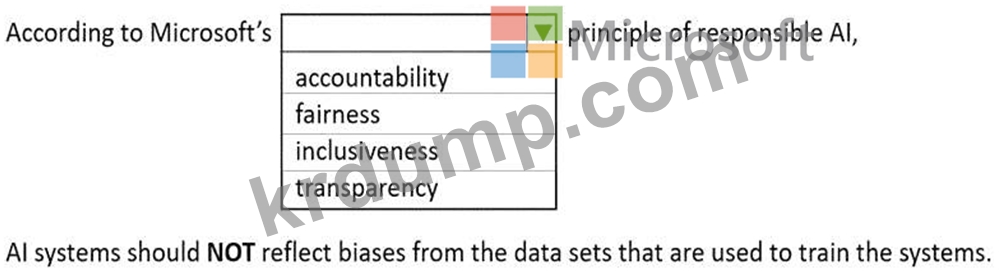
문장을 완성하려면 답변란에서 적절한 옵션을 선택하세요.
정답:
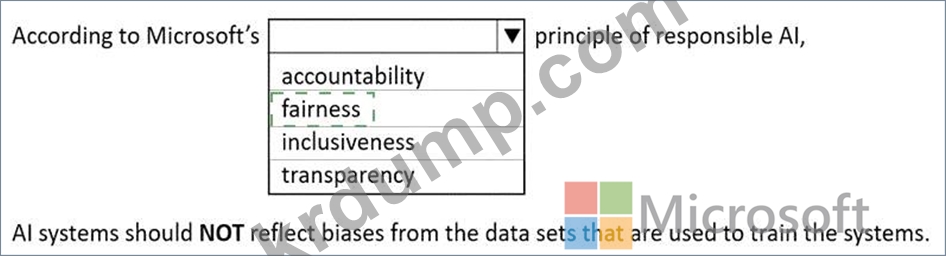
Explanation:
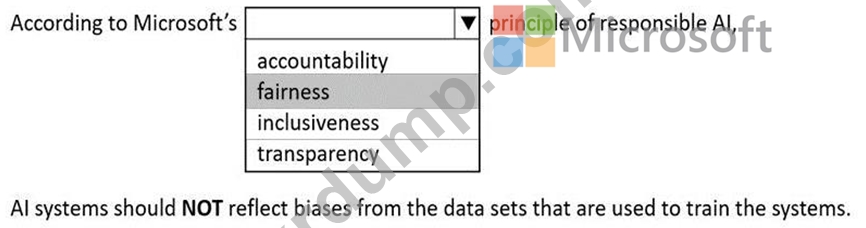
According to Microsoft's Responsible AI principles, one of the six core principles is fairness, which ensures that AI systems treat all individuals equitably and that their outcomes are not influenced by biases present in the training data or algorithms. The official Microsoft Learn module "Identify the guiding principles for responsible AI" clearly defines fairness as the requirement that AI systems should not amplify or perpetuate existing societal biases.
In this scenario, the statement emphasizes that AI systems should NOT reflect biases from the datasets used to train them, which directly aligns with the fairness principle. Bias in AI models can arise when the data used for training is unbalanced or not representative of the real-world population. For instance, if a facial recognition model is trained mostly on images of one demographic group, it may perform poorly on others- an example of unfair bias. Microsoft advocates building and testing AI systems with diverse, high-quality datasets to ensure fair performance across all groups.
The other principles listed-accountability, inclusiveness, and transparency-are also important but do not directly address bias mitigation:
* Accountability ensures that people remain responsible for AI systems and their decisions.
* Inclusiveness promotes accessibility and usability for all people, including those with disabilities.
* Transparency focuses on explaining how AI systems make decisions.
However, Fairness explicitly deals with avoiding discrimination and bias in AI outcomes and training data.
Thus, in Microsoft's Responsible AI framework, ensuring that systems do not reflect biases from datasets is part of the Fairness principle, which promotes equitable and unbiased treatment for all individuals in AI- driven decisions.
AI-900-KR 문제 107
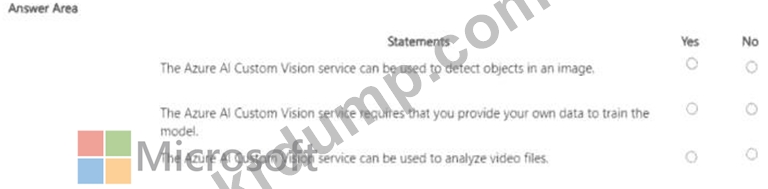
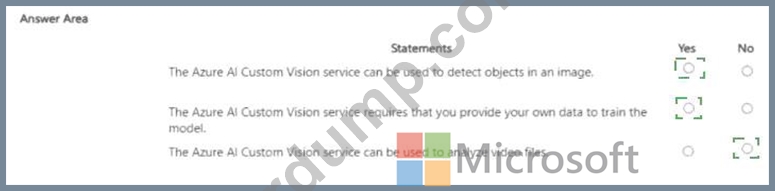
다음 각 문장에 대해, 문장이 사실이라면 '예'를 선택하세요. 그렇지 않으면 '아니요'를 선택하세요.
참고: 정답 하나당 1점입니다.
참고: 정답 하나당 1점입니다.
정답:
Explanation:
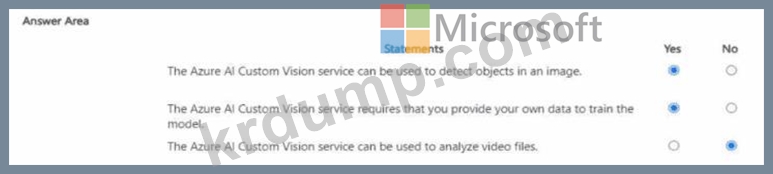
According to the Microsoft Azure AI Fundamentals (AI-900) official study guide and Microsoft Learn documentation for Azure AI Custom Vision, this service is a specialized part of the Azure AI Vision family that enables developers to train custom image classification and object detection models. It allows organizations to build tailored computer vision models that recognize images or specific objects relevant to their business needs.
* Detect objects in an image # YesThe Azure AI Custom Vision service supports both image classification (assigning an image to one or more categories) and object detection (identifying and locating objects within an image using bounding boxes). This means it can indeed detect and differentiate multiple objects in a single image, making this statement true.
* Requires your own data to train the model # YesThe Custom Vision service is designed to be customizable. Unlike prebuilt Azure AI Vision models that work out of the box, Custom Vision requires you to upload and label your own dataset for training. The model then learns from your examples to perform specialized image recognition tasks relevant to your domain. Thus, this statement is also true.
* Analyze video files # NoWhile Custom Vision can analyze images, it does not directly process or analyze video files. Video analysis is handled by a different service-Azure Video Indexer-which can extract insights such as spoken words, scenes, and faces from videos.
In summary:
# Yes - Detect objects in images
# Yes - Requires your own data
# No - Does not analyze video files.
AI-900-KR 문제 108
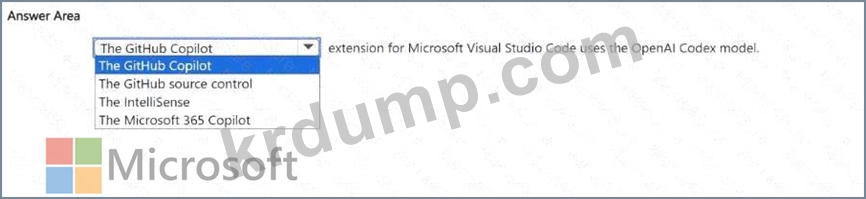
문장을 올바르게 완성하는 답을 선택하세요.
정답:
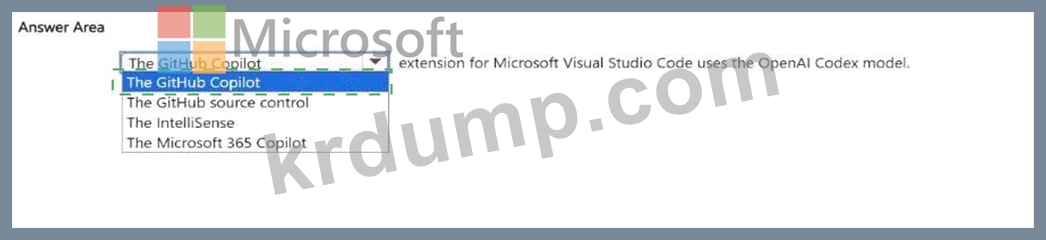
Explanation:

According to the Microsoft Azure AI Fundamentals (AI-900) official study materials and Microsoft Learn documentation on GitHub Copilot, the GitHub Copilot extension for Microsoft Visual Studio Code (VS Code) is powered by the OpenAI Codex model, a specialized descendant of the GPT (Generative Pre-trained Transformer) family of models. The OpenAI Codex model is specifically fine-tuned for programming tasks- it understands and generates code in multiple programming languages such as Python, JavaScript, C#, and more.
GitHub Copilot functions as an AI-powered coding assistant that suggests complete lines or blocks of code, helps write comments, and can even generate functions based on natural language prompts entered by the developer. When a user types a comment like "// sort a list of numbers in ascending order," Copilot uses the Codex model to understand the intent and generate an appropriate code implementation.
The integration with Visual Studio Code allows developers to work efficiently without needing to switch between documentation and their coding environment. GitHub Copilot leverages context-aware suggestions, meaning it understands the surrounding code, function definitions, and variable names to provide relevant completions.
The other options are incorrect because:
* GitHub source control manages code repositories but doesn't use AI models.
* IntelliSense is a built-in VS Code feature for code completion but doesn't rely on OpenAI models.
* Microsoft 365 Copilot uses large language models (like GPT-4) for productivity tools such as Word, Excel, and Outlook-not for code generation.
Therefore, the correct choice that uses the OpenAI Codex model in Visual Studio Code is GitHub Copilot, aligning with Microsoft's AI-900 learning objectives under "Identify common use cases for Azure OpenAI and GitHub Copilot."
AI-900-KR 문제 109
Azure에서 자연어 처리 솔루션을 개발하고 있습니다. 이 솔루션은 고객 리뷰를 분석하여 각 리뷰의 긍정적 또는 부정적 정도를 판단합니다.
이는 어떤 유형의 자연어 처리 작업 부하의 예입니까?
이는 어떤 유형의 자연어 처리 작업 부하의 예입니까?
정답: B
According to the Microsoft Azure AI Fundamentals (AI-900) Official Study Guide and the Microsoft Learn module "Explore natural language processing (NLP) in Azure," sentiment analysis is a core natural language processing (NLP) workload used to determine the emotional tone or attitude expressed in a piece of text. It helps identify whether a statement, review, or comment conveys a positive, negative, neutral, or mixed sentiment.
In this question, the scenario involves analyzing customer reviews and determining how positive or negative each review is. This directly aligns with sentiment analysis, which evaluates subjective text and quantifies the expressed opinion. In Azure, this workload is implemented through the Azure AI Language service (formerly Text Analytics API), where the Sentiment Analysis feature assigns a sentiment score to text inputs and classifies them accordingly.
For example:
* "I love this product!" # Positive sentiment
* "It's okay, but could be better." # Neutral or mixed sentiment
* "I'm disappointed with the service." # Negative sentiment
Let's analyze why the other options are incorrect:
* A. Language detection: Identifies which language (e.g., English, Spanish, French) the text is written in.
It doesn't measure positivity or negativity.
* C. Key phrase extraction: Identifies the main topics or keywords in text (e.g., "battery life," "customer support"), not the emotion.
* D. Entity recognition: Detects and categorizes specific entities such as people, locations, organizations, or dates within the text.
Therefore, based on Microsoft's AI-900 syllabus and Azure AI Language documentation, the workload that analyzes text to determine positive or negative opinions is Sentiment Analysis (Option B). This capability is widely used in customer feedback analysis, brand monitoring, and social media analytics to understand public perception and improve business decisions.
In this question, the scenario involves analyzing customer reviews and determining how positive or negative each review is. This directly aligns with sentiment analysis, which evaluates subjective text and quantifies the expressed opinion. In Azure, this workload is implemented through the Azure AI Language service (formerly Text Analytics API), where the Sentiment Analysis feature assigns a sentiment score to text inputs and classifies them accordingly.
For example:
* "I love this product!" # Positive sentiment
* "It's okay, but could be better." # Neutral or mixed sentiment
* "I'm disappointed with the service." # Negative sentiment
Let's analyze why the other options are incorrect:
* A. Language detection: Identifies which language (e.g., English, Spanish, French) the text is written in.
It doesn't measure positivity or negativity.
* C. Key phrase extraction: Identifies the main topics or keywords in text (e.g., "battery life," "customer support"), not the emotion.
* D. Entity recognition: Detects and categorizes specific entities such as people, locations, organizations, or dates within the text.
Therefore, based on Microsoft's AI-900 syllabus and Azure AI Language documentation, the workload that analyzes text to determine positive or negative opinions is Sentiment Analysis (Option B). This capability is widely used in customer feedback analysis, brand monitoring, and social media analytics to understand public perception and improve business decisions.
AI-900-KR 문제 110
귀사는 스마트 홈 기기에 음성 인식 기술을 도입하는 방안을 모색하고 있습니다. 특정 사용자 집단을 의도치 않게 배제할 수 있는 장벽을 파악하고자 합니다.
이는 책임 있는 AI에 대한 Microsoft의 지침 원칙의 예입니까?
이는 책임 있는 AI에 대한 Microsoft의 지침 원칙의 예입니까?
정답: C
According to the Microsoft Azure AI Fundamentals (AI-900) Official Study Guide and the Microsoft Responsible AI Framework, Inclusiveness is one of the six guiding principles for responsible AI. The principle of inclusiveness ensures that AI systems are designed to empower everyone and engage people of all abilities. Microsoft emphasizes that inclusive AI systems must be developed with awareness of potential barriers that could unintentionally exclude certain user groups. This directly aligns with the scenario described-where the company is examining voice recognition technologies in smart home devices to identify barriers that might leave out users, such as those with speech impairments, accents, or language differences.
The official Microsoft Learn module "Identify guiding principles for responsible AI" explains that inclusiveness focuses on creating systems that can understand and serve users with diverse needs. For example, voice recognition models should account for variations in dialect, tone, accent, and speech patterns to ensure equitable access for all. A lack of inclusiveness could cause bias or misrecognition for underrepresented groups, leading to unintentional exclusion.
Microsoft's guidance further stresses that designing for inclusiveness involves involving diverse users in the data collection and testing phases, conducting accessibility assessments, and continuously improving model performance across different demographic groups. In this way, inclusiveness promotes fairness, accessibility, and usability across cultural and physical differences.
In contrast:
* A. Accountability is about ensuring humans are responsible for AI outcomes.
* B. Fairness focuses on preventing bias and discrimination in data or algorithms.
* D. Privacy and security ensure protection of personal data and secure handling of information.
Thus, evaluating potential barriers that could exclude specific user groups exemplifies Inclusiveness, as it demonstrates a proactive approach to making AI accessible and beneficial for all users.
The official Microsoft Learn module "Identify guiding principles for responsible AI" explains that inclusiveness focuses on creating systems that can understand and serve users with diverse needs. For example, voice recognition models should account for variations in dialect, tone, accent, and speech patterns to ensure equitable access for all. A lack of inclusiveness could cause bias or misrecognition for underrepresented groups, leading to unintentional exclusion.
Microsoft's guidance further stresses that designing for inclusiveness involves involving diverse users in the data collection and testing phases, conducting accessibility assessments, and continuously improving model performance across different demographic groups. In this way, inclusiveness promotes fairness, accessibility, and usability across cultural and physical differences.
In contrast:
* A. Accountability is about ensuring humans are responsible for AI outcomes.
* B. Fairness focuses on preventing bias and discrimination in data or algorithms.
* D. Privacy and security ensure protection of personal data and secure handling of information.
Thus, evaluating potential barriers that could exclude specific user groups exemplifies Inclusiveness, as it demonstrates a proactive approach to making AI accessible and beneficial for all users.
- 다른 버전
- 2020Microsoft.AI-900-KR.v2026-05-11.q134
- 1502Microsoft.AI-900-KR.v2026-03-02.q135
- 1922Microsoft.AI-900-KR.v2026-02-07.q121
- 4334Microsoft.AI-900-KR.v2026-01-05.q136
- 1704Microsoft.AI-900-KR.v2026-01-01.q158
- 최근 업로드
- 1367Salesforce.AP-223.v2026-09-01.q94
- 1001Splunk.SPLK-5001.v2026-09-01.q60
- 1136Cisco.300-540.v2026-09-01.q62
- 3048Microsoft.MS-102-KR.v2026-09-01.q239
- 1554Microsoft.AI-900-KR.v2026-09-01.q162
- 4367Microsoft.AZ-104-KR.v2026-08-31.q361
- 1855Microsoft.PL-400-KR.v2026-08-31.q166
- 2479USGBC.LEED-Green-Associate-KR.v2026-08-31.q214
- 149HP.HPE0-V27-KR.v2026-08-31.q76
- 131Microsoft.DP-700-KR.v2026-08-31.q62
[×]
PDF 파일 다운로드
메일 주소를 입력하시고 다운로드 하세요. Microsoft.AI-900-KR.v2026-09-01.q162 모의시험 시험자료를 다운 받으세요.