

AI-900-KR 문제 31
문장을 올바르게 완성하는 답을 선택하세요.

정답:

Explanation:

According to the Microsoft Azure AI Fundamentals (AI-900) Official Study Guide and the Microsoft Learn module "Explore fundamental principles of machine learning," regression is a supervised machine learning technique used to predict continuous numeric values based on input data.
In this scenario, the goal is to predict how many hours of overtime a delivery person will work depending on the number of orders received. The output - the number of overtime hours - is a continuous variable (for example, 1.5 hours, 3.2 hours, etc.), not a category. This makes it a regression problem, where the model learns patterns from historical data and uses those patterns to estimate a continuous numeric outcome.
Why Regression Applies Here:
Regression models work by finding the mathematical relationship between input features (independent variables) and output values (dependent variables). In this case:
* Input (feature): Number of orders received
* Output (label): Predicted overtime hours
Azure Machine Learning supports several regression algorithms, including Linear Regression, Decision Tree Regression, and Neural Network Regression, all of which can handle scenarios where a numeric prediction is required.
Why Not the Other Options:
* Classification: Used for predicting discrete categories or labels (e.g., "on-time" vs. "late"). It does not output continuous numbers.
* Clustering: An unsupervised learning technique used to group data points with similar characteristics, not to make numeric predictions.
Thus, when the output variable is a numeric prediction (such as hours, prices, quantities, or time), the correct machine learning task is Regression.
AI-900-KR 문제 32
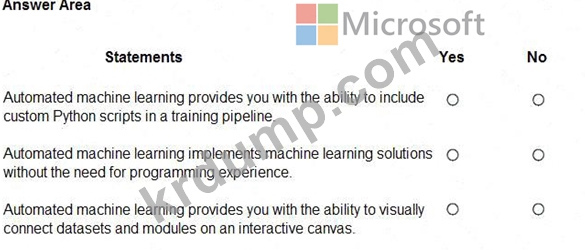
다음 각 문장에 대해, 문장이 사실이라면 '예'를 선택하세요. 그렇지 않으면 '아니요'를 선택하세요.
참고: 정답 하나당 1점입니다.
참고: 정답 하나당 1점입니다.
정답:
Explanation:
According to the Microsoft Azure AI Fundamentals (AI-900) study guide and Azure Machine Learning documentation, Automated Machine Learning (AutoML) is a feature designed to help users build, train, and tune machine learning models automatically without requiring deep knowledge of programming or data science.
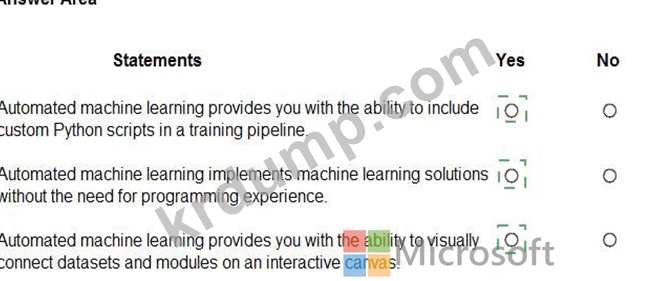
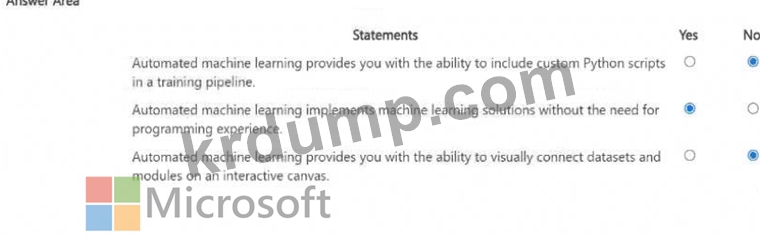
* First Statement: "Automated machine learning provides you with the ability to include custom Python scripts in a training pipeline."This is False (No). AutoML automates the model selection and tuning process but does not allow the inclusion of custom Python scripts within its workflow. Custom Python integration is supported in Azure Machine Learning designer pipelines or SDK-based training, not in AutoML.
* Second Statement: "Automated machine learning implements machine learning solutions without the need for programming experience."This is True (Yes). One of AutoML's core benefits is that it enables non-programmers to train and evaluate models by simply selecting data, choosing a target column, and letting Azure automatically test algorithms and hyperparameters. This aligns with Microsoft's AI-900 objective to democratize AI development.
* Third Statement: "Automated machine learning provides you with the ability to visually connect datasets and modules on an interactive canvas."This is False (No). That feature belongs to Azure Machine Learning Designer, not AutoML. The designer offers a drag-and-drop visual interface for connecting datasets and modules, whereas AutoML provides a wizard-driven approach focused on automation.
AI-900-KR 문제 33
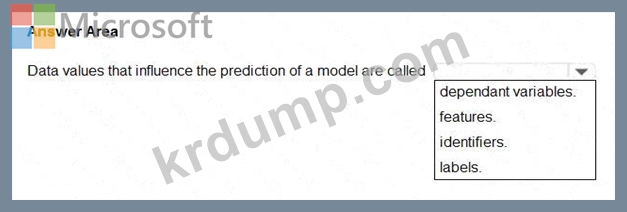
문장을 완성하려면 답변란에서 적절한 옵션을 선택하세요.
정답:
Explanation:
Features
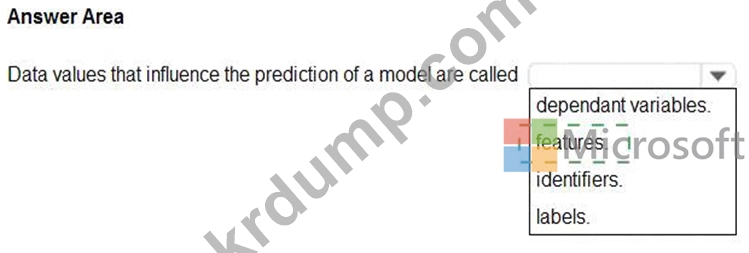
According to the Microsoft Azure AI Fundamentals (AI-900) official study guide and the Microsoft Learn module "Explore fundamental principles of machine learning," data values that influence the prediction of a model are called features. In the context of machine learning, a feature is an individual measurable property, attribute, or input variable used by the model to make predictions.
Features are the independent variables that describe the characteristics of the data. For example, in a housing price prediction model, features might include square footage, location, number of bedrooms, and year built.
These inputs help the model understand relationships in the data so it can predict the target outcome (the house price).
Microsoft Learn explains that features are the input variables that the algorithm uses to identify patterns and relationships in the training data. During training, the model learns how changes in these features influence the label (also known as the dependent variable or target variable). The label is the value the model tries to predict-such as "price," "category," or "yes/no." Here's how the other options differ:
* Dependent variables (labels): These are the outcomes or target values the model predicts, not the inputs.
* Identifiers: These are unique keys (like customer ID or transaction ID) used to distinguish records but not to influence predictions.
* Labels: As mentioned, labels are the results the model tries to predict.
Therefore, based on the AI-900 learning objectives and Microsoft's official explanation, the data values that influence the prediction of a model-that is, the input variables that guide the model's learning-are called features. These features form the foundation of the model's predictive capabilities and directly impact its accuracy and performance.
AI-900-KR 문제 34
다음 각 문장에 대해, 문장이 사실이라면 '예'를 선택하세요. 그렇지 않으면 '아니요'를 선택하세요.
참고: 정답 하나당 1점입니다.
참고: 정답 하나당 1점입니다.
정답:
Explanation:
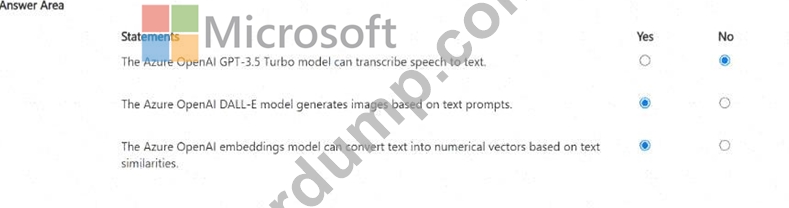
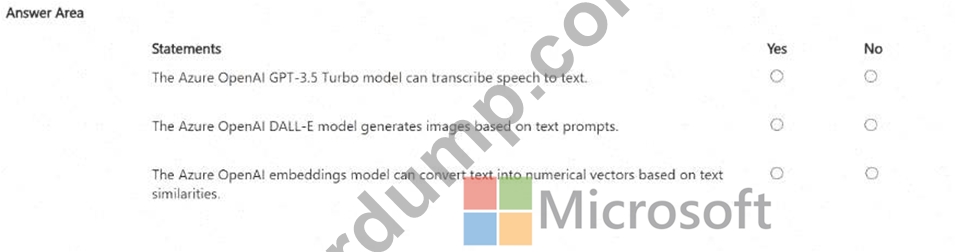
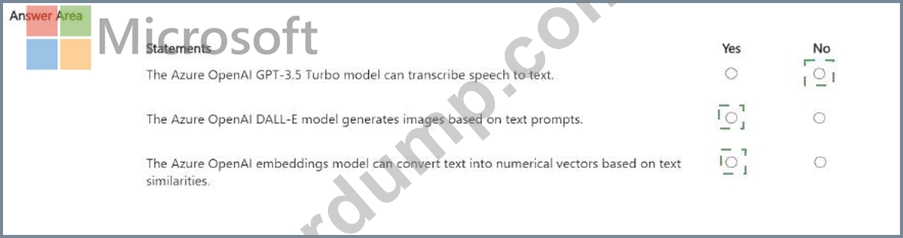
* "The Azure OpenAI GPT-3.5 Turbo model can transcribe speech to text." - NOThis statement is false.
The GPT-3.5 Turbo model is a text-based large language model (LLM) designed for natural language understanding and generation, such as answering questions, summarizing text, or writing content. It does not process or transcribe audio input. Speech-to-text capabilities belong to Azure AI Speech Services, specifically the Speech-to-Text API, not Azure OpenAI.
* "The Azure OpenAI DALL-E model generates images based on text prompts." - YESThis statement is true. The DALL-E model, available within Azure OpenAI Service, is a generative AI model that creates original images from natural language descriptions (text prompts). For example, given a prompt like "a futuristic city at sunset," DALL-E generates a unique, high-quality image representing that concept. This aligns with generative AI workloads in the AI-900 study guide, where DALL-E is specifically mentioned as an image-generation model.
* "The Azure OpenAI embeddings model can convert text into numerical vectors based on text similarities." - YESThis statement is also true. The embeddings model in Azure OpenAI converts text into multi-dimensional numeric vectors that represent semantic meaning. These embeddings enable tasks such as semantic search, recommendations, and text clustering by comparing similarity scores between vectors. Words or phrases with similar meanings have vectors close together in the embedding space.
In summary:
* GPT-3.5 Turbo # Text generation (not speech-to-text)
* DALL-E # Image generation from text prompts
* Embeddings # Convert text into numerical semantic representations
Correct selections: No, Yes, Yes.
AI-900-KR 문제 35
어떤 두 가지 상황에서 Form Recognizer 서비스를 사용할 수 있나요? 각 정답은 완전한 해결책을 제시합니다.
참고: 정답 하나당 1점입니다.
참고: 정답 하나당 1점입니다.
정답: A,D
The correct answers are A and D because both scenarios involve extracting structured information from documents, which is exactly what Azure Form Recognizer is designed to do.
According to the Microsoft Azure AI Fundamentals (AI-900) official study guide and Microsoft Learn module "Explore computer vision", Form Recognizer is an Azure Cognitive Service that uses advanced Optical Character Recognition (OCR) and machine learning to extract key-value pairs, tables, and text from structured and semi-structured documents such as receipts, invoices, business cards, and forms. It allows organizations to automate data entry and digitize document processing.
* A. Extract the invoice number from an invoice # CorrectForm Recognizer can identify fields such as invoice number, total amount, date, vendor name, and billing address directly from invoices. It uses prebuilt models for invoices and receipts that automatically detect and extract relevant information without requiring extensive manual labeling. As stated in Microsoft Learn, "Form Recognizer extracts information from documents like receipts and invoices and returns structured data including key-value pairs."
* D. Identify the retailer from a receipt # CorrectThe prebuilt receipt model in Form Recognizer can read printed or scanned receipts and extract data points such as retailer name, transaction date, total amount, and tax information. This makes it ideal for expense reporting, auditing, or financial reconciliation.
The following options are incorrect:
* B. Translate a form from French to English # This task involves language translation, which is performed by Azure Translator, not Form Recognizer.
* C. Find an image of a product in a catalog # This requires object detection or image classification, which are part of Computer Vision, not Form Recognizer.
Therefore, based on Microsoft's AI-900 learning objectives and documentation, the two correct scenarios are:
# A. Extract the invoice number from an invoice
# D. Identify the retailer from a receipt
According to the Microsoft Azure AI Fundamentals (AI-900) official study guide and Microsoft Learn module "Explore computer vision", Form Recognizer is an Azure Cognitive Service that uses advanced Optical Character Recognition (OCR) and machine learning to extract key-value pairs, tables, and text from structured and semi-structured documents such as receipts, invoices, business cards, and forms. It allows organizations to automate data entry and digitize document processing.
* A. Extract the invoice number from an invoice # CorrectForm Recognizer can identify fields such as invoice number, total amount, date, vendor name, and billing address directly from invoices. It uses prebuilt models for invoices and receipts that automatically detect and extract relevant information without requiring extensive manual labeling. As stated in Microsoft Learn, "Form Recognizer extracts information from documents like receipts and invoices and returns structured data including key-value pairs."
* D. Identify the retailer from a receipt # CorrectThe prebuilt receipt model in Form Recognizer can read printed or scanned receipts and extract data points such as retailer name, transaction date, total amount, and tax information. This makes it ideal for expense reporting, auditing, or financial reconciliation.
The following options are incorrect:
* B. Translate a form from French to English # This task involves language translation, which is performed by Azure Translator, not Form Recognizer.
* C. Find an image of a product in a catalog # This requires object detection or image classification, which are part of Computer Vision, not Form Recognizer.
Therefore, based on Microsoft's AI-900 learning objectives and documentation, the two correct scenarios are:
# A. Extract the invoice number from an invoice
# D. Identify the retailer from a receipt
- 다른 버전
- 2020Microsoft.AI-900-KR.v2026-05-11.q134
- 1501Microsoft.AI-900-KR.v2026-03-02.q135
- 1922Microsoft.AI-900-KR.v2026-02-07.q121
- 4334Microsoft.AI-900-KR.v2026-01-05.q136
- 1704Microsoft.AI-900-KR.v2026-01-01.q158
- 최근 업로드
- 1271Salesforce.AP-223.v2026-09-01.q94
- 942Splunk.SPLK-5001.v2026-09-01.q60
- 1039Cisco.300-540.v2026-09-01.q62
- 2798Microsoft.MS-102-KR.v2026-09-01.q239
- 1394Microsoft.AI-900-KR.v2026-09-01.q162
- 4011Microsoft.AZ-104-KR.v2026-08-31.q361
- 1699Microsoft.PL-400-KR.v2026-08-31.q166
- 2284USGBC.LEED-Green-Associate-KR.v2026-08-31.q214
- 148HP.HPE0-V27-KR.v2026-08-31.q76
- 131Microsoft.DP-700-KR.v2026-08-31.q62
[×]
PDF 파일 다운로드
메일 주소를 입력하시고 다운로드 하세요. Microsoft.AI-900-KR.v2026-09-01.q162 모의시험 시험자료를 다운 받으세요.