

AI-900-KR 문제 41
Azure AI 문서 인텔리전스 서비스(이전 명칭: Form Recognizer)를 사용할 수 있는 두 가지 시나리오는 무엇입니까? 각 정답은 완전한 해결책을 제시합니다.
참고: 정답 하나당 1점입니다.
참고: 정답 하나당 1점입니다.
정답: A,B
The Azure AI Document Intelligence service (formerly Form Recognizer) is designed to analyze, extract, and structure data from scanned or digital documents such as invoices, receipts, contracts, and forms. According to the Microsoft Learn module "Extract data from documents with Azure AI Document Intelligence", the service uses optical character recognition (OCR) and pretrained machine learning models to automatically extract key information.
* A. Extract the invoice number from an invoice - YESThe prebuilt invoice model in Document Intelligence can detect and extract key fields such as invoice number, date, total amount, tax, and vendor details from scanned or digital invoices.
* B. Identify the retailer from a receipt - YESThe prebuilt receipt model can recognize fields like merchant name (retailer), transaction date, total spent, and tax amount, making this option correct as well.
* C. Find images of products in a catalog - NOThis is a computer vision or Custom Vision use case, not a document data extraction task.
* D. Translate a form from French to English - NOTranslation involves Azure AI Translator, part of the Language service, not Document Intelligence.
Hence, the correct and Microsoft-verified answers are:
# A. Extract the invoice number from an invoice
# B. Identify the retailer from a receipt
* A. Extract the invoice number from an invoice - YESThe prebuilt invoice model in Document Intelligence can detect and extract key fields such as invoice number, date, total amount, tax, and vendor details from scanned or digital invoices.
* B. Identify the retailer from a receipt - YESThe prebuilt receipt model can recognize fields like merchant name (retailer), transaction date, total spent, and tax amount, making this option correct as well.
* C. Find images of products in a catalog - NOThis is a computer vision or Custom Vision use case, not a document data extraction task.
* D. Translate a form from French to English - NOTranslation involves Azure AI Translator, part of the Language service, not Document Intelligence.
Hence, the correct and Microsoft-verified answers are:
# A. Extract the invoice number from an invoice
# B. Identify the retailer from a receipt
AI-900-KR 문제 42
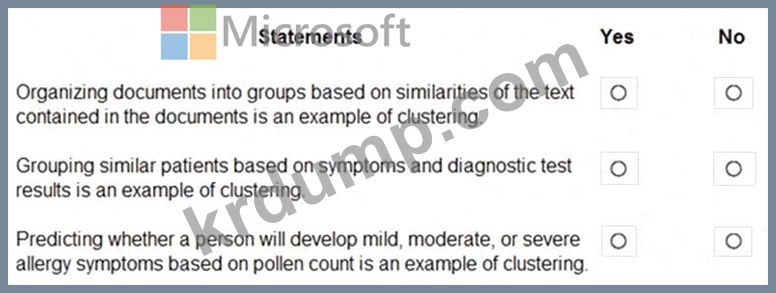
다음 각 문장에 대해, 문장이 사실이라면 '예'를 선택하세요. 그렇지 않으면 '아니요'를 선택하세요.
참고: 정답 하나당 1점입니다.
참고: 정답 하나당 1점입니다.
정답:
Explanation:
This question evaluates understanding of clustering-an unsupervised learning technique explained in the Microsoft Azure AI Fundamentals (AI-900) official study guide and Microsoft Learn module "Explore fundamental principles of machine learning." Clustering involves finding natural groupings within data without prior knowledge of output labels. The algorithm identifies similarities among data points and groups them accordingly, with each group (or cluster) containing items that are more similar to each other than to those in other groups.
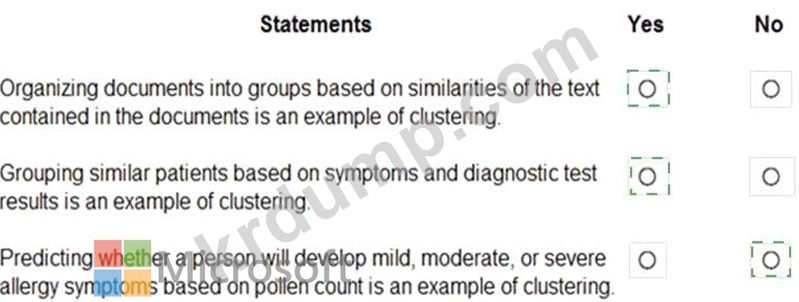
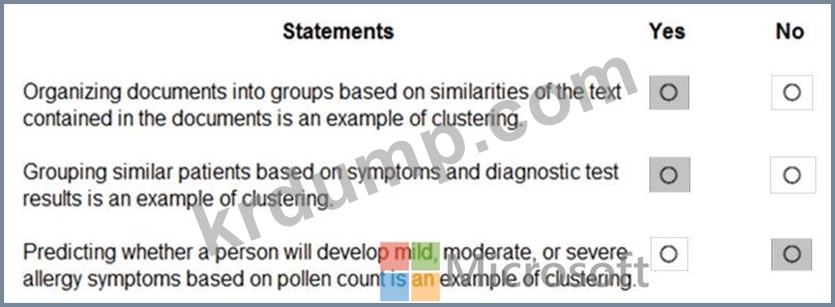
* Organizing documents into groups based on similarities of the text contained in the documents # YesThis is a classic clustering application. In text analytics or natural language processing (NLP), clustering algorithms such as K-means or hierarchical clustering are used to group documents with similar content or topics. According to Microsoft Learn, "clustering identifies relationships in data and groups items that share common characteristics." Therefore, organizing text documents based on content similarity is a textbook example of clustering.
* Grouping similar patients based on symptoms and diagnostic test results # YesThis is another example of clustering. In healthcare analytics, clustering can be used to segment patients with similar health patterns or risks. The study guide emphasizes that clustering can "discover natural groupings in data such as customers with similar buying patterns or patients with similar clinical results." Thus, this task correctly describes unsupervised clustering because it does not involve predicting a known outcome but grouping based on similarity.
* Predicting whether a person will develop mild, moderate, or severe allergy symptoms based on pollen count # NoThis is a classification problem, not clustering. Classification is a supervised learning technique where the model is trained with labeled data to predict predefined categories (in this case, mild, moderate, or severe). Microsoft Learn clearly distinguishes between clustering (discovering hidden patterns) and classification (predicting predefined categories).
AI-900-KR 문제 43
비지도 학습의 예는 무엇입니까?
정답: B
In unsupervised machine learning, the algorithm learns patterns or structure within data without pre-labeled outputs or target values. The primary goal is to discover hidden relationships or group similar data points automatically. The Microsoft Azure AI Fundamentals (AI-900) study materials identify clustering as the key example of unsupervised learning.
In clustering, algorithms such as K-means, hierarchical clustering, or DBSCAN group data based on feature similarity. For example, a business may cluster customers by purchase behavior to discover natural customer segments without prior category labels. The model finds inherent patterns within the data rather than being told what to predict.
By contrast, classification and regression are supervised learning techniques. In supervised learning, the algorithm is trained using labeled data where correct outputs are already known. Therefore, the correct answer is B. Clustering, as it best represents unsupervised learning in Azure AI-900 principles.
In clustering, algorithms such as K-means, hierarchical clustering, or DBSCAN group data based on feature similarity. For example, a business may cluster customers by purchase behavior to discover natural customer segments without prior category labels. The model finds inherent patterns within the data rather than being told what to predict.
By contrast, classification and regression are supervised learning techniques. In supervised learning, the algorithm is trained using labeled data where correct outputs are already known. Therefore, the correct answer is B. Clustering, as it best represents unsupervised learning in Azure AI-900 principles.
AI-900-KR 문제 44
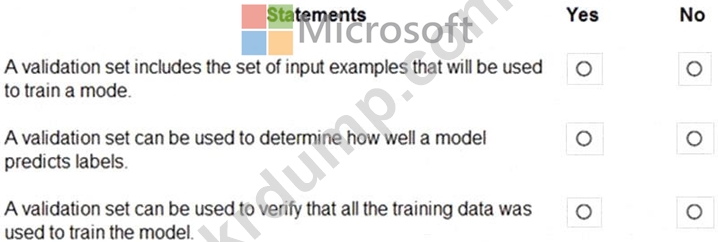
다음 각 문장에 대해, 문장이 사실이라면 '예'를 선택하세요. 그렇지 않으면 '아니요'를 선택하세요.
참고: 정답 하나당 1점입니다.
참고: 정답 하나당 1점입니다.
정답:
Explanation:
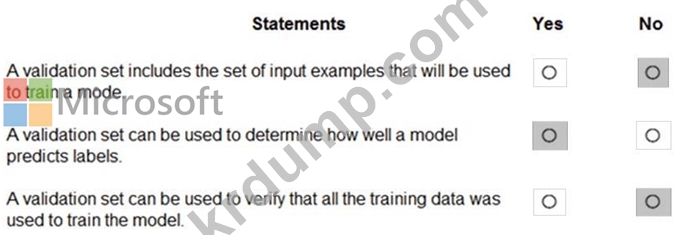
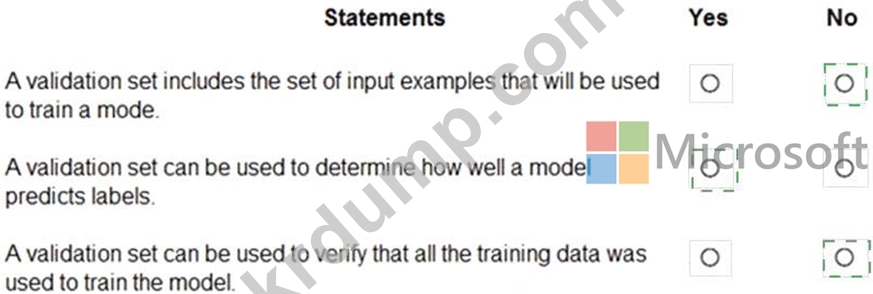
The correct answers are based on the Microsoft Azure AI Fundamentals (AI-900) Official Study Guide and the Microsoft Learn module "Explore fundamental principles of machine learning." In supervised machine learning, data is typically divided into three main subsets:
* Training set - used to train the model, i.e., to teach the algorithm the patterns and relationships between input features and output labels.
* Validation set - used to evaluate the model during training to tune hyperparameters and prevent overfitting.
* Test set - used after training to assess the final model's performance on unseen data.
Let's analyze each statement in light of these definitions:
* "A validation set includes the set of input examples that will be used to train a model." # NoThis is incorrect because the training set, not the validation set, contains the input examples used for model training. The validation set is separate from the training data to ensure unbiased evaluation.
* "A validation set can be used to determine how well a model predicts labels." # YesThis is correct. The validation set helps assess how effectively the model generalizes during training. It measures performance and helps tune model parameters for optimal results.
* "A validation set can be used to verify that all the training data was used to train the model." # NoThis is false. The validation set is not used to verify the completeness of training data usage. It exists independently to evaluate the model's performance during training cycles.
According to Microsoft Learn, using a validation set helps ensure that a model generalizes well and avoids overfitting to the training data. It plays a crucial role in refining and optimizing models before final testing.
AI-900-KR 문제 45
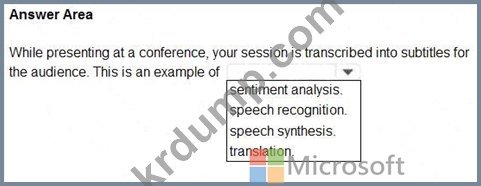
문장을 완성하려면 답변란에서 적절한 옵션을 선택하세요.
정답:
Explanation:
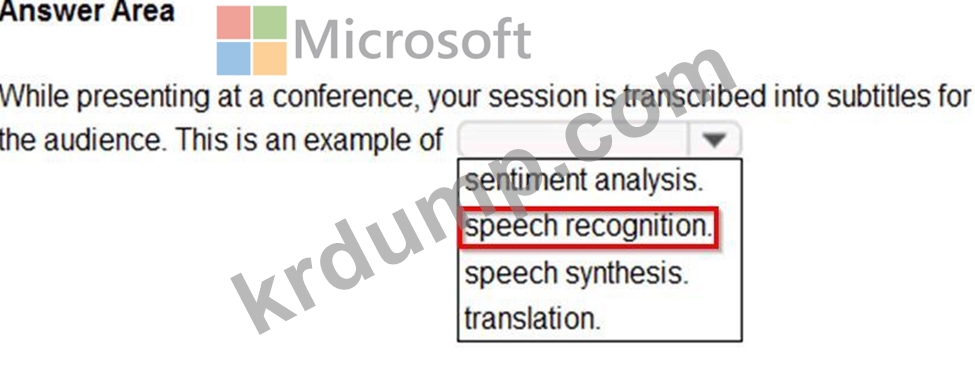
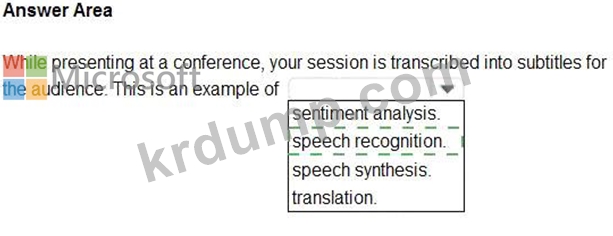
According to the Microsoft Azure AI Fundamentals (AI-900) official study guide and the Microsoft Learn module "Identify features and uses of speech capabilities", speech recognition refers to the process of converting spoken words into written text. When a speaker's voice is transcribed into subtitles during a presentation, the system listens to the audio input, identifies the spoken words, and generates corresponding text in real time. This is precisely what speech recognition technology accomplishes.
Azure provides this functionality through the Azure Speech Service, which supports multiple speech-related features:
* Speech-to-Text (Speech Recognition) - Converts spoken audio into text.
* Text-to-Speech (Speech Synthesis) - Converts written text into spoken audio.
* Speech Translation - Translates spoken words into another language.
In this case, the session is transcribed into subtitles in the same language, not translated or spoken aloud, so the correct feature is Speech Recognition.
Let's review the other options:
* Sentiment Analysis: This belongs to the Text Analytics service under natural language processing (NLP) and is used to determine the emotional tone of text, not to convert speech to text.
* Speech Synthesis: Converts text into audible speech (Text-to-Speech), the reverse of what is happening in this scenario.
* Translation: Converts spoken or written words from one language to another. Here, no translation is mentioned-only transcription.
Therefore, the described process-turning live spoken language into readable subtitles-is an example of Speech Recognition, a speech-to-text AI capability provided by Azure Cognitive Services.
Final answer: Speech recognition
Reference:Microsoft Learn - Identify speech capabilities of Azure AI services (AI-900 Learning Path)
- 다른 버전
- 2020Microsoft.AI-900-KR.v2026-05-11.q134
- 1501Microsoft.AI-900-KR.v2026-03-02.q135
- 1922Microsoft.AI-900-KR.v2026-02-07.q121
- 4334Microsoft.AI-900-KR.v2026-01-05.q136
- 1704Microsoft.AI-900-KR.v2026-01-01.q158
- 최근 업로드
- 1275Salesforce.AP-223.v2026-09-01.q94
- 944Splunk.SPLK-5001.v2026-09-01.q60
- 1040Cisco.300-540.v2026-09-01.q62
- 2807Microsoft.MS-102-KR.v2026-09-01.q239
- 1399Microsoft.AI-900-KR.v2026-09-01.q162
- 4024Microsoft.AZ-104-KR.v2026-08-31.q361
- 1704Microsoft.PL-400-KR.v2026-08-31.q166
- 2286USGBC.LEED-Green-Associate-KR.v2026-08-31.q214
- 148HP.HPE0-V27-KR.v2026-08-31.q76
- 131Microsoft.DP-700-KR.v2026-08-31.q62
[×]
PDF 파일 다운로드
메일 주소를 입력하시고 다운로드 하세요. Microsoft.AI-900-KR.v2026-09-01.q162 모의시험 시험자료를 다운 받으세요.