

AI-900-KR 문제 21
자연어 처리 작업 부하의 두 가지 예는 무엇입니까? 각 정답은 완전한 해결책을 제시합니다.
참고사항: 정답 하나당 1점입니다.
참고사항: 정답 하나당 1점입니다.
정답: B,D
The correct answers are B. a smart device in the home that responds to questions such as, "What will the weather be like today?" and D. a website that uses a knowledge base to interactively respond to users' questions.
According to the Microsoft Azure AI Fundamentals (AI-900) official study guide and Microsoft Learn module "Identify features of Natural Language Processing (NLP) workloads on Azure", Natural Language Processing (NLP) is a branch of artificial intelligence that enables computers to understand, interpret, and generate human language in a meaningful way. NLP bridges the gap between human communication and machine understanding, allowing systems to process both spoken and written language.
* Option B - A smart device in the home that responds to questions such as "What will the weather be like today?"This is an example of an NLP workload because the device must process spoken language (speech-to-text), interpret the user's intent (language understanding), and generate a relevant spoken response (text-to-speech). This workflow involves several Azure Cognitive Services, such as Speech Service for recognizing and synthesizing speech, and Language Understanding (LUIS) for interpreting intent. This aligns with conversational AI and NLP tasks in the AI-900 syllabus.
* Option D - A website that uses a knowledge base to interactively respond to users' questions.This is also an NLP workload because the system interprets text input from users and retrieves appropriate answers from a knowledge base. Microsoft's QnA Maker (now part of the Azure AI Language service) and Azure Bot Service enable such behavior. The model uses NLP to understand the user's question, find the most relevant response, and generate an appropriate reply - key characteristics of natural language processing.
Incorrect options:
* A (assembly line machinery) represents automation or robotics, not NLP.
* C (monitoring temperature to activate a fan) is an example of an IoT (Internet of Things) or rule-based system, not related to language processing.
According to the Microsoft Azure AI Fundamentals (AI-900) official study guide and Microsoft Learn module "Identify features of Natural Language Processing (NLP) workloads on Azure", Natural Language Processing (NLP) is a branch of artificial intelligence that enables computers to understand, interpret, and generate human language in a meaningful way. NLP bridges the gap between human communication and machine understanding, allowing systems to process both spoken and written language.
* Option B - A smart device in the home that responds to questions such as "What will the weather be like today?"This is an example of an NLP workload because the device must process spoken language (speech-to-text), interpret the user's intent (language understanding), and generate a relevant spoken response (text-to-speech). This workflow involves several Azure Cognitive Services, such as Speech Service for recognizing and synthesizing speech, and Language Understanding (LUIS) for interpreting intent. This aligns with conversational AI and NLP tasks in the AI-900 syllabus.
* Option D - A website that uses a knowledge base to interactively respond to users' questions.This is also an NLP workload because the system interprets text input from users and retrieves appropriate answers from a knowledge base. Microsoft's QnA Maker (now part of the Azure AI Language service) and Azure Bot Service enable such behavior. The model uses NLP to understand the user's question, find the most relevant response, and generate an appropriate reply - key characteristics of natural language processing.
Incorrect options:
* A (assembly line machinery) represents automation or robotics, not NLP.
* C (monitoring temperature to activate a fan) is an example of an IoT (Internet of Things) or rule-based system, not related to language processing.
AI-900-KR 문제 22
다음 각 문장에 대해, 문장이 사실이라면 '예'를 선택하세요. 그렇지 않으면 '아니요'를 선택하세요.
참고: 정답 하나당 1점입니다.

참고: 정답 하나당 1점입니다.
정답:
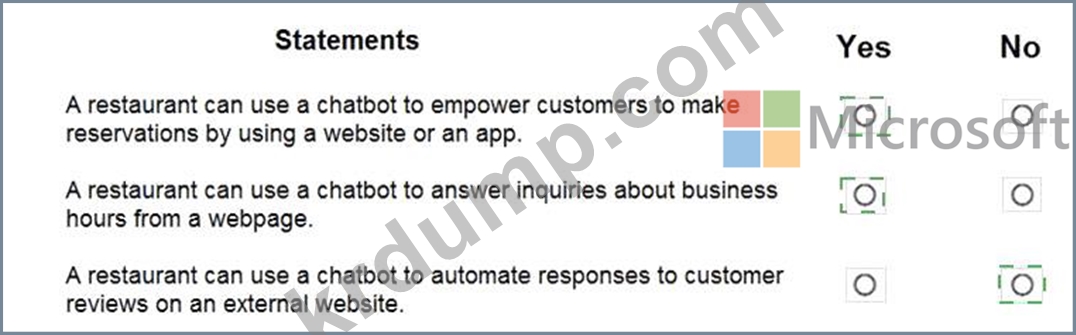
Explanation:
Yes, Yes, and No.
According to the Microsoft Azure AI Fundamentals (AI-900) official study guide and Microsoft Learn modules under the topic "Describe features of common AI workloads", conversational AI solutions like chatbots are used to automate and enhance customer interactions. A chatbot is an AI service capable of understanding user inputs (text or voice) and providing appropriate responses, often integrated into websites, mobile apps, or messaging platforms.
* A restaurant can use a chatbot to empower customers to make reservations using a website or an app - Yes.This statement is true because conversational AI is designed to handle structured tasks such as booking, scheduling, and information retrieval. Chatbots built with Azure Bot Service can connect to backend systems (like a reservation database) to let customers make or modify reservations through a chat interface. The AI-900 study guide explicitly notes that chatbots can help businesses "automate processes such as booking or reservations" to improve efficiency and customer experience.
* A restaurant can use a chatbot to answer inquiries about business hours from a webpage - Yes.This is also true. Chatbots can be trained using QnA Maker (now integrated into Azure AI Language) or Azure Cognitive Services for Language to answer common customer questions. FAQs such as opening hours, menu details, and directions are ideal for chatbot automation, as outlined in the AI-900 modules discussing customer support automation.
* A restaurant can use a chatbot to automate responses to customer reviews on an external website - No.
This is not a typical chatbot use case taught in AI-900. Chatbots are meant for direct interactions within controlled channels, such as a company's own website or messaging app. Managing and posting responses to reviews on external platforms (like Yelp or Google Reviews) would involve policy restrictions, authentication issues, and reputational risk. The AI-900 course specifies that responsible AI usage requires maintaining human oversight in public-facing communications that influence brand image.
AI-900-KR 문제 23
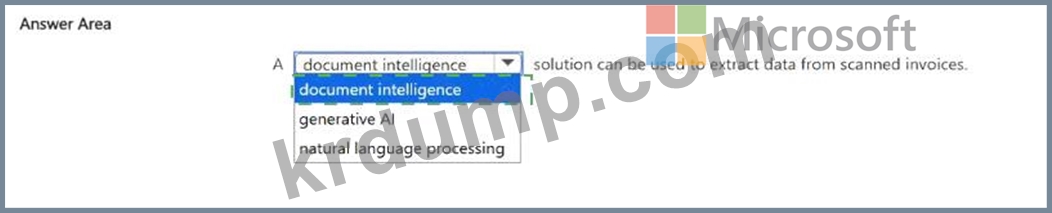
문장을 올바르게 완성하는 답을 선택하세요.

정답:
Explanation:

The correct answer is Document Intelligence.
According to the Microsoft Azure AI Fundamentals (AI-900) study materials and Microsoft Learn documentation, the Azure AI Document Intelligence service (formerly known as Form Recognizer) is specifically designed to extract structured data from documents, including scanned invoices, receipts, forms, and business cards.
This service combines optical character recognition (OCR) with machine learning to analyze both the layout and semantic meaning of document content. When processing scanned invoices, Document Intelligence identifies and extracts fields such as invoice numbers, dates, totals, taxes, vendor names, and line-item details.
The extracted information can then be automatically imported into business systems like accounting software or databases, eliminating manual data entry and improving operational efficiency.
Here's why the other options are incorrect:
* Generative AI: Focuses on creating new content such as text, images, or code (for example, using GPT-
4 or DALL E). It is not used for structured data extraction.
* Natural Language Processing (NLP): Deals with understanding and generating human language from text-based input, not document scanning or layout interpretation.
The Document Intelligence workload excels at handling semi-structured documents where the location and format of data vary between samples. Microsoft's prebuilt models-like Invoice, Receipt, Identity Document, and Contract-simplify extraction without requiring custom training.
In summary, if the task involves extracting data from scanned invoices, the appropriate Azure AI service is Azure AI Document Intelligence, which uses AI-powered document understanding to convert unstructured document images into structured, usable data.
AI-900-KR 문제 24
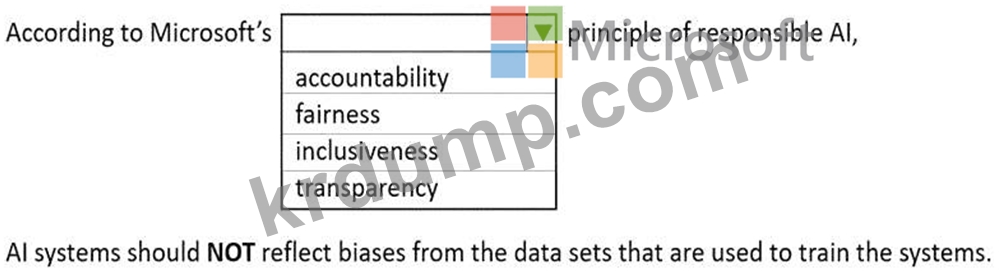
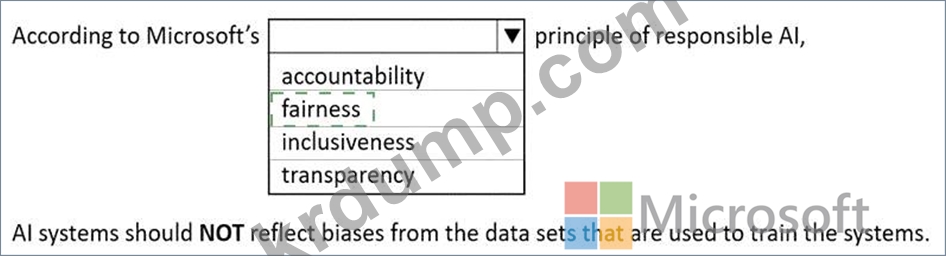
문장을 완성하려면 답변란에서 적절한 옵션을 선택하세요.
정답:
Explanation:
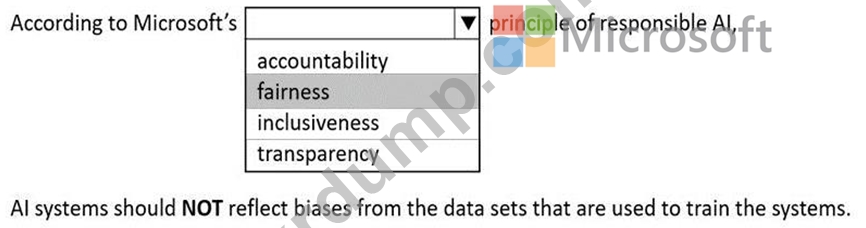
According to Microsoft's Responsible AI principles, one of the six core principles is fairness, which ensures that AI systems treat all individuals equitably and that their outcomes are not influenced by biases present in the training data or algorithms. The official Microsoft Learn module "Identify the guiding principles for responsible AI" clearly defines fairness as the requirement that AI systems should not amplify or perpetuate existing societal biases.
In this scenario, the statement emphasizes that AI systems should NOT reflect biases from the datasets used to train them, which directly aligns with the fairness principle. Bias in AI models can arise when the data used for training is unbalanced or not representative of the real-world population. For instance, if a facial recognition model is trained mostly on images of one demographic group, it may perform poorly on others- an example of unfair bias. Microsoft advocates building and testing AI systems with diverse, high-quality datasets to ensure fair performance across all groups.
The other principles listed-accountability, inclusiveness, and transparency-are also important but do not directly address bias mitigation:
* Accountability ensures that people remain responsible for AI systems and their decisions.
* Inclusiveness promotes accessibility and usability for all people, including those with disabilities.
* Transparency focuses on explaining how AI systems make decisions.
However, Fairness explicitly deals with avoiding discrimination and bias in AI outcomes and training data.
Thus, in Microsoft's Responsible AI framework, ensuring that systems do not reflect biases from datasets is part of the Fairness principle, which promotes equitable and unbiased treatment for all individuals in AI- driven decisions.
AI-900-KR 문제 25
당신은 AI 시스템을 구축하고 있습니다.
Microsoft의 책임 있는 AI에 대한 투명성 원칙을 서비스가 충족하도록 하려면 어떤 작업을 포함해야 할까요?
Microsoft의 책임 있는 AI에 대한 투명성 원칙을 서비스가 충족하도록 하려면 어떤 작업을 포함해야 할까요?
정답: C
According to the Microsoft Azure AI Fundamentals (AI-900) Official Study Guide and Microsoft Learn module "Describe principles of responsible AI", the transparency principle ensures that AI systems are understandable, explainable, and well-documented so that users, developers, and stakeholders can know how the system operates and makes decisions. Transparency involves clear communication, documentation, and interpretability.
Microsoft defines transparency as the responsibility to make sure that people understand how AI systems function, their limitations, and how decisions are made. For developers, this means providing detailed documentation and model interpretability tools so others can inspect, debug, and understand the AI model's behavior. For users, it means ensuring that the purpose, capabilities, and limitations of the AI system are clearly explained.
Providing documentation to help developers debug and understand how a service works directly aligns with this transparency principle. It ensures that the system's logic and behavior are open to inspection and that any unintended consequences can be identified and corrected. Transparency also builds trust in AI solutions by enabling accountability and oversight.
Let's analyze the other options:
* A. Ensure that all visuals have an associated text that can be read by a screen reader - This supports inclusiveness, not transparency, as it focuses on accessibility for all users.
* B. Enable autoscaling to ensure that a service scales based on demand - This is related to system performance and scalability, not responsible AI.
* D. Ensure that a training dataset is representative of the population - This supports fairness, as it prevents bias and ensures equitable outcomes.
Therefore, based on the official AI-900 training content and Microsoft's Responsible AI framework (which includes fairness, reliability, privacy, inclusiveness, transparency, and accountability), the correct answer is C.
Provide documentation to help developers debug code, because this directly promotes transparency in how the AI system operates and communicates its inner workings
Microsoft defines transparency as the responsibility to make sure that people understand how AI systems function, their limitations, and how decisions are made. For developers, this means providing detailed documentation and model interpretability tools so others can inspect, debug, and understand the AI model's behavior. For users, it means ensuring that the purpose, capabilities, and limitations of the AI system are clearly explained.
Providing documentation to help developers debug and understand how a service works directly aligns with this transparency principle. It ensures that the system's logic and behavior are open to inspection and that any unintended consequences can be identified and corrected. Transparency also builds trust in AI solutions by enabling accountability and oversight.
Let's analyze the other options:
* A. Ensure that all visuals have an associated text that can be read by a screen reader - This supports inclusiveness, not transparency, as it focuses on accessibility for all users.
* B. Enable autoscaling to ensure that a service scales based on demand - This is related to system performance and scalability, not responsible AI.
* D. Ensure that a training dataset is representative of the population - This supports fairness, as it prevents bias and ensures equitable outcomes.
Therefore, based on the official AI-900 training content and Microsoft's Responsible AI framework (which includes fairness, reliability, privacy, inclusiveness, transparency, and accountability), the correct answer is C.
Provide documentation to help developers debug code, because this directly promotes transparency in how the AI system operates and communicates its inner workings
- 최근 업로드
- 106USGBC.LEED-Green-Associate-KR.v2026-01-08.q154
- 119Adobe.AD0-E608-KR.v2026-01-08.q54
- 165HP.HPE7-A08.v2026-01-08.q272
- 130Cisco.300-835.v2026-01-08.q117
- 113Workday.Workday-Pro-Integrations.v2026-01-08.q18
- 106CompTIA.CV0-004.v2026-01-08.q215
- 105Juniper.JN0-253.v2026-01-08.q61
- 105CertNexus.AIP-210.v2026-01-08.q63
- 188ISACA.CRISC.v2026-01-07.q193
- 157PECB.ISO-9001-Lead-Auditor.v2026-01-07.q191
[×]
PDF 파일 다운로드
메일 주소를 입력하시고 다운로드 하세요. Microsoft.AI-900-KR.v2026-01-05.q136 모의시험 시험자료를 다운 받으세요.