

AI-900-KR 문제 56
참고: 정답 하나당 1점입니다.
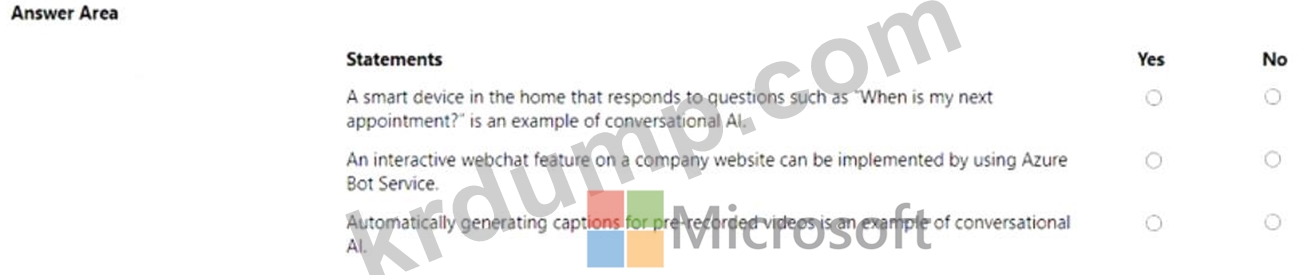
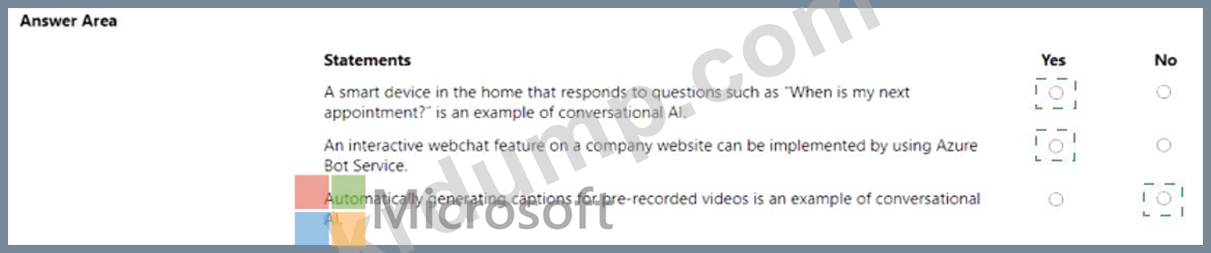
Explanation:
< Smart home device answering questions # Yes
Webchat using Azure Bot Service # Yes
Auto-caption generation for videos # No
According to the Microsoft Azure AI Fundamentals (AI-900) official study guide and the Microsoft Learn module "Describe features of common AI workloads", Conversational AI refers to systems designed to engage in human-like dialogue through natural language-either text or speech. These systems include chatbots, virtual assistants, and voice-enabled smart devices, all of which can interpret user intent and respond meaningfully.
* A smart device in the home that responds to questions such as "When is my next appointment?" - Yes.
This is a classic example of Conversational AI. Devices like smart speakers or personal digital assistants use speech recognition, natural language understanding (NLU), and language generation to interpret spoken input and respond conversationally. The AI-900 study materials identify these as examples of voice-based conversational AI systems, which fall under the Speech and Language AI workloads.
* An interactive webchat feature on a company website can be implemented by using Azure Bot Service
- Yes.This statement is true. The Azure Bot Service is the primary Microsoft tool for creating and deploying conversational bots across various channels, including websites, Microsoft Teams, and other messaging platforms. The AI-900 syllabus specifically cites this as an example of implementing conversational AI for customer support or information retrieval.
* Automatically generating captions for pre-recorded videos is an example of conversational AI - No.
This is not conversational AI; instead, it falls under the Speech AI workload, specifically speech-to-text transcription. Automatically generating captions involves converting audio from video into written text but does not involve dialogue or interaction between a user and a system.
Thus, based on the official AI-900 guidance, only the first two scenarios describe conversational AI use cases.
AI-900-KR 문제 57
The Azure Bot Service integrates with the Bot Framework SDK to design intelligent chatbots that can communicate with users in natural language. It also connects seamlessly with other Azure Cognitive Services, such as Language Service (LUIS) for intent understanding and Speech Service for voice input/output.
The question specifies that the conversational AI must be accessible through multiple platforms, including Microsoft Teams, Cortana, and Alexa. Azure Bot Service supports this multi-channel communication model out of the box, allowing developers to configure a single bot that interacts through many endpoints simultaneously.
Other options:
* B. Azure Cognitive Search: Used for information retrieval and knowledge mining, not conversational AI.
* C. Language Service: Provides natural language understanding, key phrase extraction, sentiment analysis, etc., but doesn't handle multi-channel communication.
* D. Speech: Provides speech-to-text and text-to-speech conversion but is not a chatbot platform.
Therefore, the best solution for building and deploying a multi-channel conversational AI system is Azure Bot Service, as clearly defined in Microsoft's AI-900 learning content.
AI-900-KR 문제 58
QnA Maker enables developers to take semi-structured text (for example, an FAQ document or webpage) and automatically generate a knowledge base of pairs of questions and corresponding answers. This knowledge base can then be connected to a chatbot, typically through the Azure Bot Service, so that users can interact with it conversationally. The key advantage is that the process does not require deep machine learning or programming expertise. The service uses natural language processing (NLP) to match user queries with the most relevant pre-defined answers in the knowledge base.
In the AI-900 curriculum, this falls under the Conversational AI workload-creating intelligent bots that can respond naturally to user questions. Microsoft's training content explains that "QnA Maker extracts pairs of question and answer from your content and builds a knowledge base that can be queried by bots and other applications." The output, as shown in the example diagram, demonstrates how user input (the question) triggers a request to the QnA Maker API, which returns a JSON response containing the best-matched answer.
The other options are not correct because:
* B. Language Understanding (LUIS) is used to interpret user intent and extract entities, not to create FAQs.
* C. Text Analytics performs text extraction, sentiment analysis, and key-phrase detection but does not build a Q&A knowledge base.
* D. Speech handles speech-to-text or text-to-speech, not Q&A matching.
Therefore, per the AI-900 study guide and Microsoft Learn, the verified and correct answer is A. QnA Maker.
AI-900-KR 문제 59
다음 그림에 표시된 출력을 받게 됩니다.

어떤 유형의 자연어 처리가 수행되었습니까?
https://docs.microsoft.com/en-us/learn/modules/analyze-text-with-text-analytics-service/2-get-started-azure
AI-900-KR 문제 60
In this scenario, the goal is to build an image tagging solution that automatically tags images of friends on social media. This requires the ability to recognize and match faces of known individuals, which is a key feature of the Face API. The API uses facial recognition technology to create face IDs for detected faces and can compare new faces against stored face data to identify known individuals. Microsoft Learn notes: "The Face service can detect, recognize, and identify people in images, enabling automated tagging or authentication scenarios." Other options explained:
* A. Computer Vision identifies objects, landmarks, and general content but does not specialize in identifying individual people.
* C. Text Analytics analyzes textual data for sentiment, key phrases, or entities, not image data.
* D. Form Recognizer extracts structured data from forms or receipts, unrelated to face detection.
Thus, for automatically tagging people in photos, Azure Face is the correct and most suitable service.
- 다른 버전
- 4044Microsoft.AI-900-KR.v2026-09-01.q162
- 2331Microsoft.AI-900-KR.v2026-05-11.q134
- 1759Microsoft.AI-900-KR.v2026-03-02.q135
- 2192Microsoft.AI-900-KR.v2026-02-07.q121
- 2001Microsoft.AI-900-KR.v2026-01-01.q158
- 최근 업로드
- 125Oracle.1Z0-1053-26.v2026-10-19.q32
- 121Oracle.1Z0-1053-26.v2026-10-19.q31
- 131EMC.D-ECS-DY-23.v2026-10-19.q67
- 144Salesforce.Field-Service-Consultant.v2026-10-19.q136
- 159ACFE.CFE-Fraud-Prevention-and-Deterrence.v2026-10-18.q194
- 157Oracle.1Z0-1048-26.v2026-10-17.q66
- 179Splunk.SPLK-3003.v2026-10-17.q106
- 170Nokia.SRAN-Radio-Network-Performance-Optimization.v2026-10-16.q18
- 191Pegasystems.PEGACPRSA22V1.v2026-10-16.q33
- 205PaloAltoNetworks.XSIAM-Analyst.v2026-10-15.q75
PDF 파일 다운로드
메일 주소를 입력하시고 다운로드 하세요. Microsoft.AI-900-KR.v2026-01-05.q136 모의시험 시험자료를 다운 받으세요.