Explanation:

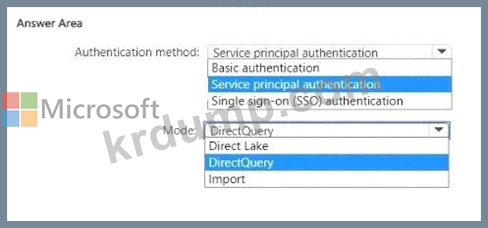
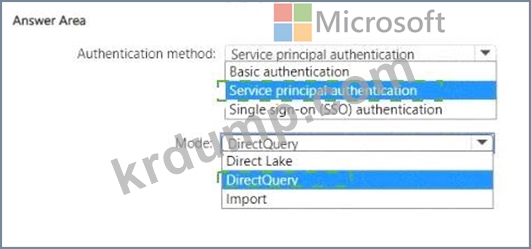
For the semantic model design required for the customer satisfaction report, the choices for data source authentication method and mode should be made based on security and performance considerations as per the case study provided.
Authentication method: The data should be accessed securely, and given that row-level security (RLS) is required for users executing T-SQL queries, you should use an authentication method that supports RLS.
Service principal authentication is suitable for automated and secure access to the data, especially when the access needs to be controlled programmatically and is not tied to a specific user ' s credentials.
Mode: The report needs to show data as soon as it is updated in the data store, and it should only contain data from the current and previous year. DirectQuery mode allows for real-time reporting without importing data into the model, thus meeting the need for up-to-date data. It also allows for RLS to be implemented and enforced at the data source level, providing the necessary security measures.
Based on these considerations, the selections should be:
Authentication method: Service principal authentication
Mode: DirectQuery
Topic 2, Contoso, ltd.
Overview
Contoso, ltd. is a US-based health supplements company, Contoso has two divisions named Sales and Research. The Sales division contains two departments named Online Sales and Retail Sales. The Research division assigns internally developed product lines to individual teams of researchers and analysts.
Identity Environment
Contoso has a Microsoft Entra tenant named contoso.com. The tenant contains two groups named ResearchReviewersGroupi and ReseachReviewefsGfoup2.
Data Environment
Contoso has the following data environment
* The Sales division uses a Microsoft Power B1 Premium capacity.
* The semantic model of the Online Sales department includes a fact table named Orders that uses import mode. In the system of origin, the OrderlD value represents the sequence in which orders are created.
* The Research department uses an on-premises. third-party data warehousing product.
* Fabric is enabled for contoso.com.
* An Azure Data Lake Storage Gen2 storage account named storage1 contains Research division data for a product line named Producthne1. The data is in the delta format.
* A Data Lake Storage Gen2 storage account named storage2 contains Research division data for a product line named Productline2. The data is in the CSV format.
Planned Changes
Contoso plans to make the following changes:
* Enable support for Fabric in the Power Bl Premium capacity used by the Sales division.
* Make all the data for the Sales division and the Research division available in Fabric.
* For the Research division, create two Fabric workspaces named Producttmelws and Productline2ws.
* in Productlinelws. create a lakehouse named LakehouseV
* In Lakehouse1. create a shortcut to storage1 named ResearchProduct.
Data Analytics Requirements
Contoso identifies the following data analytics requirements:
* All the workspaces for the Sales division and the Research division must support all Fabric experiences.
* The Research division workspaces must use a dedicated, on-demand capacity that has per-minute billing.
* The Research division workspaces must be grouped together logically to support OneLake data hub filtering based on the department name.
* For the Research division workspaces, the members of ResearchRevtewersGroupl must be able to read lakehouse and warehouse data and shortcuts by using SQL endpoints.
* For the Research division workspaces, the members of ResearchReviewersGroup2 must be able to read lakehouse data by using Lakehouse explorer.
* All the semantic models and reports for the Research division must use version control that supports branching Data Preparation Requirements Contoso identifies the following data preparation requirements:
* The Research division data for Producthne2 must be retrieved from Lakehouset by using Fabric notebooks.
* All the Research division data in the lakehouses must be presented as managed tables in Lakehouse explorer.
Semantic Model Requirements
Contoso identifies the following requirements for implementing and managing semantic models;
* The number of rows added to the Orders table during refreshes must be minimized.
* The semantic models in the Research division workspaces must use Direct Lake mode.
General Requirements
Contoso identifies the following high-level requirements that must be considered for all solutions:
* Follow the principle of least privilege when applicable
* Minimize implementation and maintenance effort when possible.