

AI-900-KR 문제 71
참고: 정답 하나당 1점입니다.
Explanation:
Statement
Yes / No
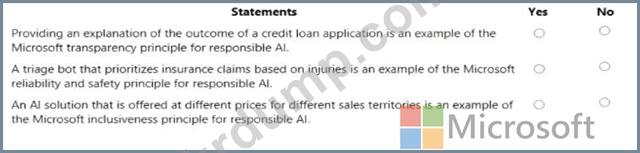
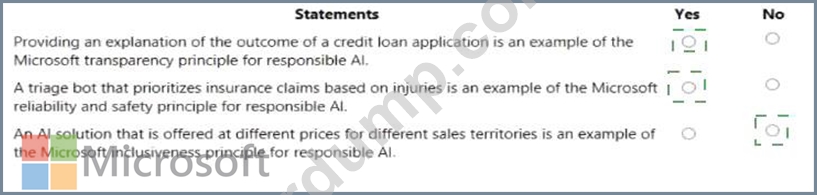
Providing an explanation of the outcome of a credit loan application is an example of the Microsoft transparency principle for responsible AI.
Yes
A triage bot that prioritizes insurance claims based on injuries is an example of the Microsoft reliability and safety principle for responsible AI.
Yes
An AI solution that is offered at different prices for different sales territories is an example of the Microsoft inclusiveness principle for responsible AI.
No
This question is based on the Responsible AI principles defined by Microsoft, a major topic in the AI-900:
Microsoft Azure AI Fundamentals certification. The goal of Responsible AI is to ensure that artificial intelligence is developed and used ethically, safely, and transparently to benefit people and society. Microsoft' s framework defines six core principles: Fairness, Reliability and Safety, Privacy and Security, Inclusiveness, Transparency, and Accountability.
* Transparency Principle - YesProviding an explanation for a loan application decision clearly reflects transparency. According to Microsoft's Responsible AI guidelines, transparency involves ensuring that users and stakeholders understand how AI systems make decisions. When a financial AI model explains why a loan was approved or denied, it promotes user trust and confidence in automated decision- making. Transparency helps individuals understand influencing factors (like income or credit score), thereby fostering ethical AI deployment.
* Reliability and Safety Principle - YesA triage bot that prioritizes insurance claims based on injury severity demonstrates reliability and safety. This principle ensures that AI systems consistently operate as intended, handle data accurately, and do not cause unintended harm. For a triage bot, safety means it must correctly interpret medical or claim information and consistently provide appropriate prioritization. Microsoft emphasizes that reliable AI systems must be tested rigorously, function correctly in various scenarios, and maintain user safety at all times.
* Inclusiveness Principle - NoAn AI solution priced differently for various sales territories is unrelated to inclusiveness. Inclusiveness focuses on designing AI systems that are accessible and fair to all users, including those with disabilities or from different demographic backgrounds. Price variation across territories is a business strategy, not an ethical AI inclusion concern. Hence, this statement does not align with any Responsible AI principle.
AI-900-KR 문제 72
900) official study guide and Microsoft Learn module "Evaluate model performance", classification models are evaluated using metrics that measure how accurately the model predicts categorical outcomes such as "yes
/no," "spam/not spam," or "approved/denied."
The True Positive Rate measures the proportion of correctly identified positive cases out of all actual positive cases. Mathematically, it is expressed as:
True Positive Rate (Recall)=True PositivesTrue Positives + False Negatives\text{True Positive Rate (Recall)}
= \frac{\text{True Positives}}{\text{True Positives + False Negatives}}True Positive Rate (Recall)
=True Positives + False NegativesTrue Positives
This metric is important when missing positive predictions carries a high cost, such as in medical diagnosis or fraud detection. Microsoft Learn highlights classification evaluation metrics such as accuracy, precision, recall, F1 score, and AUC (Area Under the Curve) as suitable for classification models.
The other options-Mean Absolute Error (MAE), Root Mean Squared Error (RMSE), and Coefficient of Determination (R²)-are regression metrics used to evaluate models that predict numeric values rather than categories. For example, they apply to predicting house prices or temperatures, not yes/no decisions.
Therefore, the correct classification evaluation metric among the choices is A. True Positive Rate.
Reference:Microsoft Learn - Evaluate model performance - Understand metrics for classification and regression models
AI-900-KR 문제 73


Explanation:

The correct answer is Azure AI Custom Vision.
According to the Microsoft Azure AI Fundamentals (AI-900) official study guide and the Microsoft Learn module "Explore computer vision in Azure", the Azure AI Custom Vision service is specifically designed to allow users to train, test, and deploy custom image classification and object detection models using their own images.
The Azure AI Custom Vision service extends the capabilities of Azure's general-purpose Computer Vision API by enabling organizations to upload their own labeled datasets, define custom tags (labels), and train models that are optimized for their specific use cases. This makes it ideal for object detection scenarios-such as detecting equipment in a manufacturing line, identifying products on store shelves, or recognizing medical images-where general-purpose models may not suffice.
By contrast, the Azure AI Computer Vision service provides pre-built models for tasks such as image description, tagging, face detection, and OCR (optical character recognition). It does not allow users to train their own models with custom data. Similarly, Azure AI Document Intelligence is used for extracting structured information from documents (forms, receipts, invoices), and Azure Video Analyzer for Media focuses on analyzing video content for insights and metadata extraction.
The AI-900 study guide emphasizes that the Custom Vision service supports two key model types:
* Image Classification - categorizing entire images based on predefined tags.
* Object Detection - identifying and locating multiple objects within an image by drawing bounding boxes.
Therefore, when the question specifies "train an object detection model by using your own images," the correct Azure service is Azure AI Custom Vision, as it provides the necessary tools for training, evaluating, and deploying custom computer vision models tailored to a user's dataset.
Hence, the verified correct answer is: Azure AI Custom Vision.
AI-900-KR 문제 74
The Azure Bot Service integrates with the Bot Framework SDK to design intelligent chatbots that can communicate with users in natural language. It also connects seamlessly with other Azure Cognitive Services, such as Language Service (LUIS) for intent understanding and Speech Service for voice input/output.
The question specifies that the conversational AI must be accessible through multiple platforms, including Microsoft Teams, Cortana, and Alexa. Azure Bot Service supports this multi-channel communication model out of the box, allowing developers to configure a single bot that interacts through many endpoints simultaneously.
Other options:
* B. Azure Cognitive Search: Used for information retrieval and knowledge mining, not conversational AI.
* C. Language Service: Provides natural language understanding, key phrase extraction, sentiment analysis, etc., but doesn't handle multi-channel communication.
* D. Speech: Provides speech-to-text and text-to-speech conversion but is not a chatbot platform.
Therefore, the best solution for building and deploying a multi-channel conversational AI system is Azure Bot Service, as clearly defined in Microsoft's AI-900 learning content.
AI-900-KR 문제 75
요약을 생성하려면 보고서에서 주요 용어를 추출해야 합니다.
어떤 유형의 AI 워크로드를 사용해야 합니까?
In this question, you have insurance claim reports stored as text, and you need to extract key terms to generate summaries. This matches the Text Analytics service in Azure Cognitive Services, which uses NLP techniques such as key phrase extraction to identify important concepts within textual data.
The other options are incorrect because:
* A. Conversational AI focuses on chatbots or dialogue systems.
* B. Anomaly detection identifies unusual data patterns, not textual meaning.
* D. Computer vision processes image or video content, not text.
Therefore, extracting key terms from documents is a clear example of Natural Language Processing.
Reference:Microsoft Learn - Identify features of Natural Language Processing (NLP) workloads
- 다른 버전
- 2020Microsoft.AI-900-KR.v2026-05-11.q134
- 1502Microsoft.AI-900-KR.v2026-03-02.q135
- 1922Microsoft.AI-900-KR.v2026-02-07.q121
- 4334Microsoft.AI-900-KR.v2026-01-05.q136
- 1704Microsoft.AI-900-KR.v2026-01-01.q158
- 최근 업로드
- 1367Salesforce.AP-223.v2026-09-01.q94
- 1001Splunk.SPLK-5001.v2026-09-01.q60
- 1136Cisco.300-540.v2026-09-01.q62
- 3048Microsoft.MS-102-KR.v2026-09-01.q239
- 1550Microsoft.AI-900-KR.v2026-09-01.q162
- 4367Microsoft.AZ-104-KR.v2026-08-31.q361
- 1855Microsoft.PL-400-KR.v2026-08-31.q166
- 2479USGBC.LEED-Green-Associate-KR.v2026-08-31.q214
- 149HP.HPE0-V27-KR.v2026-08-31.q76
- 131Microsoft.DP-700-KR.v2026-08-31.q62
PDF 파일 다운로드
메일 주소를 입력하시고 다운로드 하세요. Microsoft.AI-900-KR.v2026-09-01.q162 모의시험 시험자료를 다운 받으세요.