

AI-900-KR 문제 131
Azure Cognitive Services를 적절한 AI 워크로드에 맞춰 조정하세요.
답변하려면 왼쪽 열에서 해당 서비스를 오른쪽 작업 부하로 끌어다 놓으세요. 각 서비스는 한 번, 여러 번 또는 전혀 사용되지 않을 수 있습니다.
참고: 정답을 맞힐 때마다 1점이 주어집니다.

답변하려면 왼쪽 열에서 해당 서비스를 오른쪽 작업 부하로 끌어다 놓으세요. 각 서비스는 한 번, 여러 번 또는 전혀 사용되지 않을 수 있습니다.
참고: 정답을 맞힐 때마다 1점이 주어집니다.
정답:

Explanation:

The correct matches are Custom Vision, Form Recognizer, and Face - each corresponding to a distinct capability under Azure Cognitive Services as described in the Microsoft Azure AI Fundamentals (AI-900) official study guide and Microsoft Learn modules on Computer Vision workloads.
* Custom Vision # Identify objects in an imageThe Custom Vision service is part of the Azure Cognitive Services suite that enables developers to train custom image classification and object detection models.
Unlike the prebuilt Computer Vision API, Custom Vision allows users to upload their own labeled images and teach the model to recognize specific objects relevant to their business context. The AI-900 syllabus explains that Custom Vision is ideal for tasks such as identifying products on a shelf, categorizing images, or detecting defects in manufacturing.
* Form Recognizer # Automatically import data from an invoice to a databaseForm Recognizer is a document processing AI service that extracts structured data from forms, receipts, and invoices. It uses optical character recognition (OCR) combined with layout and key-value pair detection to automatically capture information such as invoice numbers, amounts, and vendor names. The AI-900 study materials highlight this service under the Document Intelligence category, emphasizing its ability to streamline data entry and business automation workflows by importing extracted data directly into databases or applications.
* Face # Identify people in an imageThe Face service provides advanced facial detection and recognition capabilities. It can locate faces in images, compare similarities between faces, identify known individuals, and even detect facial attributes such as age or emotion. The AI-900 course classifies this under Computer Vision services for person identification and security-related use cases such as access control or identity verification.
Thus, each mapping aligns precisely with the AI-900 official learning outcomes on Cognitive Services capabilities:
* Custom Vision # Object recognition
* Form Recognizer # Data extraction from forms
* Face # People identification
# Final verified configuration:
* Custom Vision # Identify objects in an image
* Form Recognizer # Automatically import data from an invoice to a database
* Face # Identify people in an image
AI-900-KR 문제 132
다음 각 문장에 대해, 문장이 사실이라면 '예'를 선택하세요. 그렇지 않으면 '아니요'를 선택하세요.
참고: 정답 하나당 1점입니다.

참고: 정답 하나당 1점입니다.
정답:

Explanation:

According to the Microsoft Azure AI Fundamentals (AI-900) official study guide and the Microsoft Learn module "Identify features of common machine learning types", there are three main types of machine learning: supervised learning, unsupervised learning, and reinforcement learning. Within supervised learning, two common approaches are regression and classification, while clustering is a primary example of unsupervised learning.
* "You train a regression model by using unlabeled data." - No.Regression models are trained with labeled data, meaning the input data includes both features (independent variables) and target labels (dependent variables) representing continuous numerical values. Examples include predicting house prices or sales forecasts. Unlabeled data (data without target output values) cannot be used to train regression models; such data is used in unsupervised learning tasks like clustering.
* "The classification technique is used to predict sequential numerical data over time." - No.
Classification is used for categorical predictions, where outputs belong to discrete classes, such as spam
/not spam or disease present/absent. Predicting sequential numerical data over time refers to time series forecasting, which is typically a regression or forecasting problem, not classification. The AI-900 syllabus clearly separates classification (categorical prediction) from regression (continuous value prediction) and time series (temporal pattern analysis).
* "Grouping items by their common characteristics is an example of clustering." - Yes.This statement is correct. Clustering is an unsupervised learning technique used to group similar data points based on their features. The AI-900 study materials describe clustering as the process of "discovering natural groupings in data without predefined labels." Common examples include customer segmentation or document grouping.
Therefore, based on Microsoft's AI-900 training objectives and definitions:
* Regression # supervised learning using labeled continuous data (No)
* Classification # categorical prediction, not sequential numeric forecasting (No)
* Clustering # grouping by similarity (Yes)
AI-900-KR 문제 133
어떤 상황에서 핵심어 추출을 사용해야 할까요?
정답: D
According to the Microsoft Azure AI Fundamentals (AI-900) official study guide and Microsoft Learn module "Extract insights from text with the Text Analytics service", key phrase extraction is a feature of the Text Analytics service that identifies the most important words or phrases in a given document. It helps summarize the main ideas by isolating significant concepts or terms that describe what the text is about.
In this scenario, the goal is to determine which documents share similar topics or themes. By extracting key phrases from each document (for example, "policy renewal," "coverage limits," "claim process"), you can compare and categorize documents based on overlapping keywords. This is exactly how key phrase extraction is used-to summarize and group text content by topic relevance.
The other options do not fit this use case:
* A. Translation uses the Translator service, not key phrase extraction.
* B. Generating video captions involves speech recognition and computer vision.
* C. Identifying sentiment relates to sentiment analysis, not key phrase extraction.
Reference:Microsoft Learn - Extract insights from text with Text Analytics
In this scenario, the goal is to determine which documents share similar topics or themes. By extracting key phrases from each document (for example, "policy renewal," "coverage limits," "claim process"), you can compare and categorize documents based on overlapping keywords. This is exactly how key phrase extraction is used-to summarize and group text content by topic relevance.
The other options do not fit this use case:
* A. Translation uses the Translator service, not key phrase extraction.
* B. Generating video captions involves speech recognition and computer vision.
* C. Identifying sentiment relates to sentiment analysis, not key phrase extraction.
Reference:Microsoft Learn - Extract insights from text with Text Analytics
AI-900-KR 문제 134
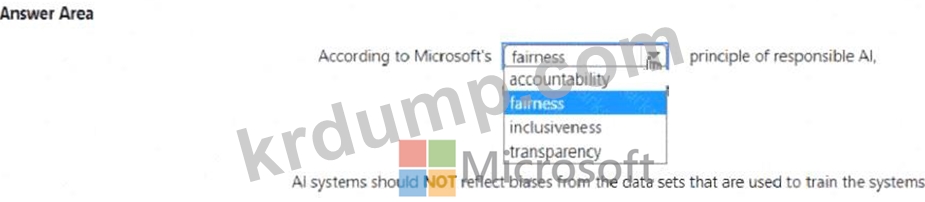
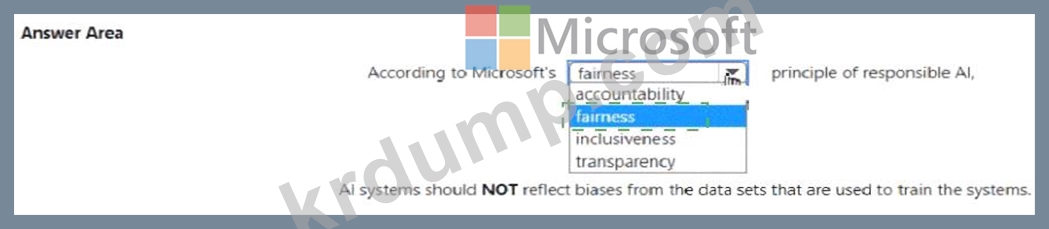
문장을 올바르게 완성하는 답을 선택하세요.
정답:
Explanation:

According to the Microsoft Azure AI Fundamentals (AI-900) Official Study Guide and the Microsoft Learn module "Identify guiding principles for responsible AI," Fairness is one of Microsoft's six core principles of Responsible AI. The principle of fairness ensures that AI systems treat all individuals and groups equitably, and that the models do not produce biased or discriminatory outcomes.
Bias in AI systems can occur when training data reflects existing prejudices, inequalities, or imbalances. For example, if a dataset used for a hiring model underrepresents a certain demographic group, the AI system might produce unfair recommendations. Microsoft emphasizes that AI should not reflect or reinforce bias and that developers must actively design, test, and monitor models to mitigate unfairness.
Microsoft's Six Responsible AI Principles:
* Fairness - AI systems should treat everyone equally and avoid bias.
* Reliability and safety - AI systems must operate as intended even under unexpected conditions.
* Privacy and security - AI must protect personal and business data.
* Inclusiveness - AI should empower all people and be accessible to diverse users.
* Transparency - AI systems should be understandable and their decisions explainable.
* Accountability - Humans should be accountable for AI system outcomes.
The other options do not fit this context:
* Accountability ensures human responsibility for AI decisions.
* Inclusiveness focuses on accessibility and empowering all users.
* Transparency relates to making AI systems understandable.
Therefore, the correct answer is fairness, as it directly addresses the principle that AI systems should NOT reflect biases from the datasets used to train them.
AI-900-KR 문제 135
특정 지역의 동물 개체수를 예측해야 합니다.
어떤 Azure Machine Learning 유형을 사용해야 합니까?
어떤 Azure Machine Learning 유형을 사용해야 합니까?
정답: C
According to the AI-900 official study materials, regression is a type of supervised machine learning used to predict continuous numeric values. Predicting the animal population of an area involves estimating a numeric quantity, which makes regression the appropriate model type.
Microsoft Learn defines regression workloads as predicting real-valued outputs, such as:
* Forecasting sales or demand.
* Predicting housing prices.
* Estimating resource usage or population sizes.
In contrast:
* Classification predicts discrete categories (e.g., "cat" or "dog").
* Clustering groups data into similar clusters but doesn't produce numeric predictions.
Therefore, because the task requires predicting a numerical population size, the verified answer is C.
Regression, as per Microsoft's AI-900 official guidelines.
Microsoft Learn defines regression workloads as predicting real-valued outputs, such as:
* Forecasting sales or demand.
* Predicting housing prices.
* Estimating resource usage or population sizes.
In contrast:
* Classification predicts discrete categories (e.g., "cat" or "dog").
* Clustering groups data into similar clusters but doesn't produce numeric predictions.
Therefore, because the task requires predicting a numerical population size, the verified answer is C.
Regression, as per Microsoft's AI-900 official guidelines.
- 다른 버전
- 4043Microsoft.AI-900-KR.v2026-09-01.q162
- 2331Microsoft.AI-900-KR.v2026-05-11.q134
- 1758Microsoft.AI-900-KR.v2026-03-02.q135
- 2192Microsoft.AI-900-KR.v2026-02-07.q121
- 2001Microsoft.AI-900-KR.v2026-01-01.q158
- 최근 업로드
- 125Oracle.1Z0-1053-26.v2026-10-19.q32
- 121Oracle.1Z0-1053-26.v2026-10-19.q31
- 129EMC.D-ECS-DY-23.v2026-10-19.q67
- 139Salesforce.Field-Service-Consultant.v2026-10-19.q136
- 159ACFE.CFE-Fraud-Prevention-and-Deterrence.v2026-10-18.q194
- 157Oracle.1Z0-1048-26.v2026-10-17.q66
- 178Splunk.SPLK-3003.v2026-10-17.q106
- 170Nokia.SRAN-Radio-Network-Performance-Optimization.v2026-10-16.q18
- 190Pegasystems.PEGACPRSA22V1.v2026-10-16.q33
- 205PaloAltoNetworks.XSIAM-Analyst.v2026-10-15.q75
[×]
PDF 파일 다운로드
메일 주소를 입력하시고 다운로드 하세요. Microsoft.AI-900-KR.v2026-01-05.q136 모의시험 시험자료를 다운 받으세요.