

AI-900-KR 문제 86
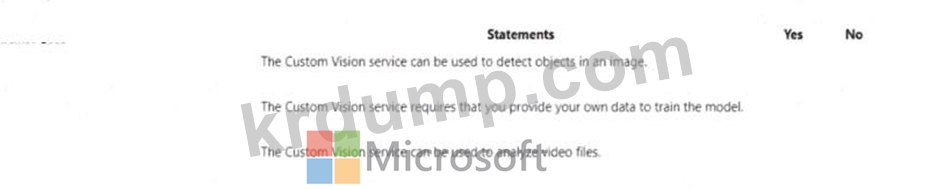
다음 각 문장에 대해, 문장이 사실이라면 '예'를 선택하세요. 그렇지 않으면 '아니요'를 선택하세요.
참고: 정답 하나당 1점입니다.
참고: 정답 하나당 1점입니다.
정답:
Explanation:
According to the Microsoft Azure AI Fundamentals (AI-900) official study guide and Microsoft Learn module "Identify features of Computer Vision workloads on Azure", the Custom Vision service is a part of Azure Cognitive Services that allows users to build, train, and deploy custom image classification and object detection models. It is primarily designed for still-image analysis, not video processing.
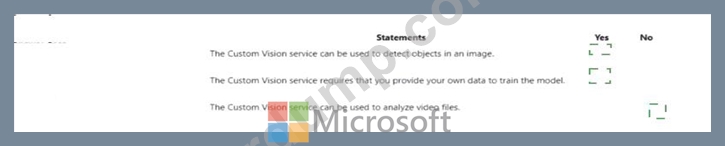
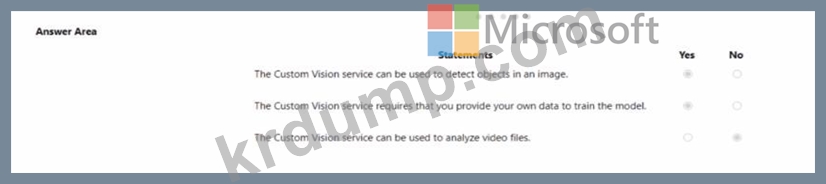
* "The Custom Vision service can be used to detect objects in an image." - Yes.This is correct. The Custom Vision service supports two major model types: classification (categorizing entire images) and object detection (identifying and locating multiple objects within a single image). In object detection mode, the model outputs both the object's category and its position in the image using bounding boxes.
This capability is emphasized in the AI-900 curriculum as an example of applying computer vision to real-world scenarios, such as identifying products on shelves or detecting equipment parts in manufacturing.
* "The Custom Vision service requires that you provide your own data to train the model." - Yes.This statement is also true. Unlike prebuilt computer vision models, Custom Vision is a trainable model that requires users to upload their own labeled images to create a domain-specific AI model. The model's accuracy depends on the quality and quantity of this user-provided data. The AI-900 study materials explain that Custom Vision is used when prebuilt models do not meet specific needs, enabling businesses to train models tailored to unique image sets.
* "The Custom Vision service can be used to analyze video files." - No.This is incorrect. Custom Vision is limited to image-based analysis. To analyze video content (detecting objects or motion in moving frames), Azure provides Video Indexer, which is a separate service designed for extracting insights from video files, including speech, objects, faces, and emotions.
AI-900-KR 문제 87
AI 기반 앱을 만들고 있습니다.
앱이 책임 있는 AI 원칙을 사용하는지 확인해야 합니다.
어떤 두 가지 원칙을 따라야 할까요? 각 정답은 해결책의 일부를 제시합니다.
참고: 정답 하나당 1점입니다.
앱이 책임 있는 AI 원칙을 사용하는지 확인해야 합니다.
어떤 두 가지 원칙을 따라야 할까요? 각 정답은 해결책의 일부를 제시합니다.
참고: 정답 하나당 1점입니다.
정답: B,C
The correct answers are B. Implement a process of AI model validation as part of the software review process and C. Establish a risk governance committee that includes members of the legal team, members of the risk management team, and a privacy officer.
According to the Microsoft Azure AI Fundamentals (AI-900) Official Study Guide and the Microsoft Responsible AI principles, responsible AI emphasizes six key principles: fairness, reliability and safety, privacy and security, inclusiveness, transparency, and accountability. These principles ensure that AI systems are trustworthy, ethical, and safe for users and society.
Option B aligns with the reliability and safety principle. Model validation ensures that AI models behave as expected, perform accurately across different data conditions, and produce consistent results. Microsoft teaches that AI models should be validated, tested, and monitored regularly to avoid unintended outcomes, bias, or failures. Validation processes help ensure that the AI behaves responsibly before deployment and continues to perform reliably over time.
Option C aligns with the accountability and governance principle. Establishing a risk governance committee that includes legal, privacy, and risk management experts ensures that AI development and deployment are overseen responsibly. This committee is responsible for reviewing compliance with data protection laws, ensuring ethical practices, and managing risks associated with AI-driven decisions. Microsoft emphasizes that accountability requires human oversight and governance structures to ensure ethical alignment throughout the AI system's lifecycle.
The incorrect options are:
* A. Implement an Agile software development methodology: Agile is a software project management approach, not a Responsible AI principle.
* D. Prevent the disclosure of the use of AI-based algorithms: This violates the transparency principle, which requires organizations to disclose when and how AI is used.
Therefore, following the official Responsible AI framework taught in AI-900, the correct and verified answers are B and C, as they directly promote reliability, safety, accountability, and governance in AI systems.
AI-900-KR 문제 88
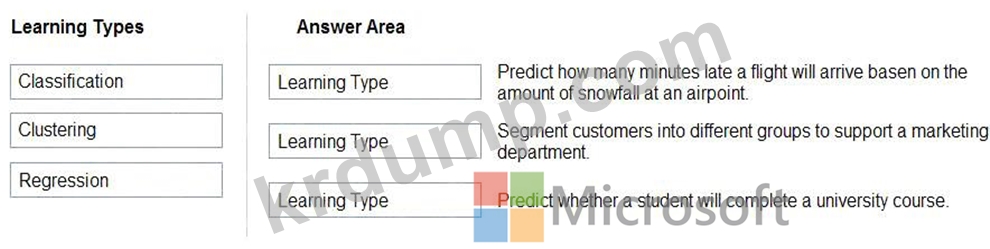
머신 러닝 유형을 적절한 시나리오에 맞춰 연결하세요.
답변하려면 왼쪽 열에서 적절한 머신 러닝 유형을 오른쪽의 시나리오로 드래그하세요. 각 머신 러닝 유형은 한 번, 여러 번 또는 전혀 사용되지 않을 수 있습니다.
참고: 정답 하나당 1점입니다.
답변하려면 왼쪽 열에서 적절한 머신 러닝 유형을 오른쪽의 시나리오로 드래그하세요. 각 머신 러닝 유형은 한 번, 여러 번 또는 전혀 사용되지 않을 수 있습니다.
참고: 정답 하나당 1점입니다.
정답:
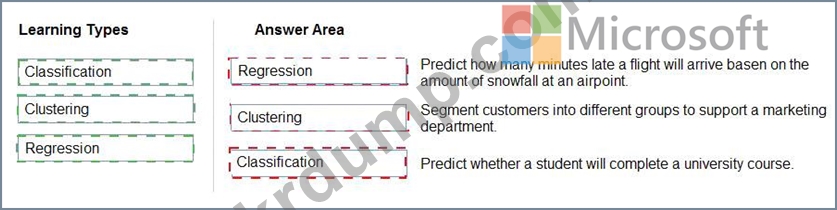
Explanation:
According to the Microsoft Azure AI Fundamentals (AI-900) official study guide and Microsoft Learn module "Describe features of common AI workloads", there are three primary supervised and unsupervised machine learning types: Regression, Classification, and Clustering. Each type of learning addresses a different kind of problem depending on the data and desired prediction output.
* Regression - Regression models are used to predict numeric, continuous values. The study guide specifies that "regression predicts a number." In the scenario "Predict how many minutes late a flight will arrive based on the amount of snowfall," the output (minutes late) is a continuous numeric value.
Therefore, this is a regression problem. Regression algorithms like linear regression or decision tree regression estimate relationships between variables and predict measurable quantities.
* Clustering - Clustering falls under unsupervised learning, where the model identifies natural groupings or patterns in unlabeled data. The official AI-900 training material states that "clustering is used to find groups or segments of data that share similar characteristics." The scenario "Segment customers into different groups to support a marketing department" fits this description because the goal is to group customers based on behavior or demographics without predefined labels. Thus, it is a clustering problem.
* Classification - Classification is a supervised learning method used to predict discrete categories or labels. The AI-900 content defines classification as "predicting which category an item belongs to." The scenario "Predict whether a student will complete a university course" requires a yes/no (binary) outcome, which is a classic classification problem. Examples include logistic regression, decision trees, or neural networks trained for categorical prediction.
In summary:
* Regression # Predicts continuous numeric outcomes.
* Clustering # Groups data by similarities without predefined labels.
* Classification # Predicts discrete or categorical outcomes.
Hence, the correct and verified mappings based on the official AI-900 study material are:
* Regression # Flight delay prediction
* Clustering # Customer segmentation
* Classification # Course completion prediction
AI-900-KR 문제 89
자연어 처리를 사용하여 사용자가 지식 기반을 쿼리할 수 있는 봇을 개발할 계획입니다.
솔루션에 어떤 두 가지 서비스를 포함해야 할까요? 정답은 각각 솔루션의 일부를 나타냅니다.
참고: 정답 하나당 1점입니다.
솔루션에 어떤 두 가지 서비스를 포함해야 할까요? 정답은 각각 솔루션의 일부를 나타냅니다.
참고: 정답 하나당 1점입니다.
정답: A,B
According to the Microsoft Azure AI Fundamentals (AI-900) Official Study Guide and the Microsoft Learn module "Explore conversational AI in Microsoft Azure," conversational bots are AI applications that can understand and respond to natural language inputs through text or speech. Building such a bot typically involves two key Azure services:
* Azure Bot Service (Option B):This service provides the framework and infrastructure needed to create, test, and deploy intelligent chatbots that interact with users across multiple channels (webchat, Teams, email, etc.). It handles conversation flow, integration, and user message management.
* Azure Language Service (Option A):This service powers the natural language understanding (NLU) capability of the bot. It enables the bot to interpret user input, extract intent, and query a knowledge base using Question Answering (formerly QnA Maker). This allows the bot to respond intelligently to user questions by finding the most relevant answers.
The other options are incorrect:
* C. Form Recognizer is used for extracting structured data from documents like invoices or forms.
* D. Anomaly Detector is used for identifying unusual patterns in time-series data.
Hence, to build a bot that understands and answers user questions in natural language, the solution must combine Azure Bot Service for conversation management and Azure Language Service for knowledge-based question answering and natural language understanding.
AI-900-KR 문제 90
사진 속 동물의 수를 세어야 합니다. 어떤 유형의 컴퓨터 비전을 사용해야 할까요?
정답: D
According to the Microsoft Azure AI Fundamentals (AI-900) curriculum, computer vision encompasses several key capabilities: image classification, object detection, facial detection, and optical character recognition (OCR). When the task requires counting the number of distinct objects (in this case, animals) in an image, object detection is the correct type of vision model.
Object detection not only classifies what is present in an image but also identifies where each object appears by drawing bounding boxes around them. Each detected object is individually labeled, enabling the system to count or track them accurately. In contrast, image classification would only tell you the overall category (e.g.,
"This is an image of animals") without counting how many animals are present.
Facial detection focuses solely on identifying human faces, while OCR extracts text from images - neither applies here.
Therefore, the AI-900 official learning modules confirm that object detection is the appropriate solution for identifying and counting multiple entities within an image.
- 다른 버전
- 4045Microsoft.AI-900-KR.v2026-09-01.q162
- 2333Microsoft.AI-900-KR.v2026-05-11.q134
- 1759Microsoft.AI-900-KR.v2026-03-02.q135
- 2192Microsoft.AI-900-KR.v2026-02-07.q121
- 2003Microsoft.AI-900-KR.v2026-01-01.q158
- 최근 업로드
- 125Oracle.1Z0-1053-26.v2026-10-19.q32
- 121Oracle.1Z0-1053-26.v2026-10-19.q31
- 132EMC.D-ECS-DY-23.v2026-10-19.q67
- 144Salesforce.Field-Service-Consultant.v2026-10-19.q136
- 161ACFE.CFE-Fraud-Prevention-and-Deterrence.v2026-10-18.q194
- 157Oracle.1Z0-1048-26.v2026-10-17.q66
- 179Splunk.SPLK-3003.v2026-10-17.q106
- 170Nokia.SRAN-Radio-Network-Performance-Optimization.v2026-10-16.q18
- 191Pegasystems.PEGACPRSA22V1.v2026-10-16.q33
- 205PaloAltoNetworks.XSIAM-Analyst.v2026-10-15.q75
[×]
PDF 파일 다운로드
메일 주소를 입력하시고 다운로드 하세요. Microsoft.AI-900-KR.v2026-01-05.q136 모의시험 시험자료를 다운 받으세요.