

ISTQB-CTFL-KR 문제 86
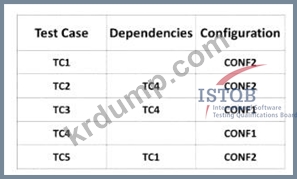
C0NF1이 테스트 환경의 초기 구성이라고 가정합니다. 이 가정을 기반으로 다음 중 지정된 종속성과 호환되고 테스트 환경의 다양한 구성 간 전환 수를 최소화할 수 있는 테스트 실행 일정은 무엇입니까?
* TC4: It has no dependencies and runs on CONF1 (initial configuration).
* TC3: Depends on TC4 and runs on CONF1. Since TC4 is already executed, we can proceed with TC3.
* TC2: Depends on TC4 and runs on CONF2. We switch to CONF2 after TC3.
* TC1: No dependencies and runs on CONF2. Since we are already in CONF2, we can execute TC1 next.
* TC5: Depends on TC1 and runs on CONF2. Since TC1 is already executed, we can proceed with TC5 without additional configuration switches.
By following this sequence (TC4, TC3, TC2, TC1, TC5), we respect the dependencies and minimize the number of configuration switches
ISTQB-CTFL-KR 문제 87
* Therefore, testing contributes to higher quality by verifying and validating that the software products and related work products meet the specified requirements, are fit for purpose and have no defects, or at least have a reduced number of defects. Testing also provides information about the quality of the software products and related work products to the stakeholders, who can make informed decisions based on the test results3.
* Out of the four given statements, only option D is an example of testing contributing to higher quality, as it shows that testing has detected a defect (a flaw in a component or system that can cause the component or system to fail to perform its required function4) and that the defect has been resolved (fixed and confirmed) prior to release (delivery of the software product to the customer or end user).
This means that testing has prevented a potential failure (an event in which a component or system does not perform a required function within specified limits) from occurring in the operational environment, and thus has improved the quality of the software product.
* Option A is not an example of testing contributing to higher quality, as it is a reporting activity that summarizes the test results and evaluates the test objectives, but does not directly affect the quality of the software product or related work products. A test summary report is a document that records and communicates the outcomes of testing activities, including testcompletion criteria, test results, incident reports, test summary and evaluation, and lessons learned.
* Option B is not an example of testing contributing to higher quality, as it is a planning activity that estimates the resources and time needed for testing activities, but does not directly affect the quality of the software product or related work products. A test effort estimate is an approximation of the amount of work and/or the duration of time required to perform testing activities.
* Option C is not an example of testing contributing to higher quality, as it is a preparation activity that sets up the test environment (an environment containing hardware, instrumentation, simulators, software tools, and other support elements needed to conduct a test), but does not directly affect the quality of the software product or related work products. A test environment installation is a process of installing and configuring the test environment according to the test environment specification.
References:
* 1: ISTQB Certified Tester Foundation Level Syllabus 2018, Version 4.0, p. 10
* 2: ISTQB Certified Tester Foundation Level Syllabus 2018, Version 4.0, p. 11
* 3: ISTQB Certified Tester Foundation Level Syllabus 2018, Version 4.0, p. 12
* 4: ISTQB Certified Tester Foundation Level Syllabus 2018, Version 4.0, p. 13
* : ISTQB Certified Tester Foundation Level Syllabus 2018, Version 4.0, p. 13
* : ISTQB Certified Tester Foundation Level Syllabus 2018, Version 4.0, p. 77
* : ISTQB Certified Tester Foundation Level Syllabus 2018, Version 4.0, p. 78
* : ISTQB Certified Tester Foundation Level Syllabus 2018, Version 4.0, p. 79
* : ISTQB Certified Tester Foundation Level Syllabus 2018, Version 4.0, p. 80
* : ISTQB Certified Tester Foundation Level Syllabus 2018, Version 4.0, p. 81
* : ISTQB Certified Tester Foundation Level Syllabus 2018, Version 4.0, p. 82
* : ISTQB Certified Tester Foundation Level Syllabus 2018, Version 4.0, p. 83
* : ISTQB Certified Tester Foundation Level Syllabus 2018, Version 4.0, p. 84
* : ISTQB Certified Tester Foundation Level Syllabus 2018, Version 4.0, p. 85
* : ISTQB Certified Tester Foundation Level Syllabus 2018, Version 4.0, p. 86
* : ISTQB Certified Tester Foundation Level Syllabus 2018, Version 4.0, p. 87
* : ISTQB Certified Tester Foundation Level Syllabus 2018, Version 4.0, p. 88
* : ISTQB Certified Tester Foundation Level Syllabus 2018, Version 4.0, p. 89
* : ISTQB Certified Tester Foundation Level Syllabus 2018, Version 4.0, p. 90
* : ISTQB Certified Tester Foundation Level Syllabus 2018, Version 4.0, p. 91
* : ISTQB Certified Tester Foundation Level Syllabus 2018, Version 4.0, p. 92
* : ISTQB Certified Tester Foundation Level Syllabus 2018, Version 4.0, p. 93
* : ISTQB Certified Tester Foundation Level Syllabus 2018, Version 4.0, p. 94
* : ISTQB Certified Tester Foundation Level Syllabus 2018, Version 4.0, p. 95
* : ISTQB Certified Tester Foundation Level Syllabus 2018, Version 4.0, p. 96
* : ISTQB Certified Tester Foundation Level Syllabus 2018, Version 4.0, p. 97
* : ISTQB Certified Tester Foundation Level Syllabus 2018, Version 4.0, p. 98
* : ISTQB Certified Tester Foundation Level Syllabus 2018, Version 4.0, p. 99
* : ISTQB Certified Tester Foundation Level Syllabus 2018, Version 4.0, p. 100
* : ISTQB Certified Tester Foundation Level Syllabus 2018, Version 4.0, p. 101
* : ISTQB Certified Tester Foundation Level Syllabus 2018, Version 4.0, p. 102
* : ISTQB Certified Tester Foundation Level Syllabus 2018, Version 4.0, p. 103
* : ISTQB Certified Tester Foundation Level Syllabus 2018, Version 4.0, p. 104
* : ISTQB Certified Tester Foundation Level Syllabus 2018, Version 4.0, p. 105
* : ISTQB Certified Tester Foundation Level Syllabus 2018, Version 4.0, p. 106
* : ISTQB Certified Tester Foundation Level Syllabus 2018, Version 4.0, p. 107
ISTQB-CTFL-KR 문제 88
2018 Syllabus - Springer, Chapter 4, page 36.
ISTQB-CTFL-KR 문제 89
To test the true outcome of the condition, we need a test case that simulates the user pressing Cancel after booking a bill. This test case will exit the loop and end the process flow.
To test the false outcome of the condition, we need a test case that simulates the user not pressing Cancel after booking a bill. This test case will repeat the loop and book another bill.
Therefore, we need at least two test cases to achieve 100% branch coverage of the process flow. One test case for each possible outcome of the condition.
Verified References: [A Study Guide to the ISTQB® Foundation Level 2018 Syllabus - Springer], Chapter 4, page 40-41.
ISTQB-CTFL-KR 문제 90
이 분석에 필요한 정보를 제공하려면 어떤 적용 범위 지표가 필요할까요?
Branch coverage is suitable for testing the cases where a specific action is not allowed, because it can verify that the test cases cover all the possible outcomes of the conditions that determine the action. For example, if the program has a condition that checks if the manufacturing stage can be stopped, then branch coverage can ensure that the test cases cover both the cases where the stage can be stopped and where it cannot be stopped.
This way, branch coverage can help identify any missing or incorrect branches that may lead to undesired or unsafe actions.
The other options are not correct because they are not suitable for testing the cases where a specific action is not allowed. Code coverage is a general term that encompasses various types of coverage metrics, such as statement coverage, branch coverage, data flow coverage, etc. Code coverage does not specify which type of coverage metric is used for the analysis. Data flow coverage is a type of structural coverage metric that measures the percentage of data flow paths that are executed by the test cases. A data flow path is a sequence of statements that define, use, or kill a variable. Data flow coverage is useful for testing the correctness and completeness of the data manipulation in the software, but not for testing the conditions that determine the actions. Statement coverage is a type of structural coverage metric that measures the percentage of statements or lines of code that are executed by the test cases. Statement coverage ensures that each statement is executed at least once by the test cases, but it does not reveal the behavior of the software under different scenarios.
Statement coverage is a weaker criterion than branch coverage, because it does not account for the branches or decision outcomes in the code. References = ISTQB Certified Tester Foundation Level (CTFL) v4.0 syllabus, Chapter 4: Test Techniques, Section 4.3: Structural Testing Techniques, Pages 51-54.
- 다른 버전
- 1313ISTQB.ISTQB-CTFL-KR.v2026-03-16.q188
- 1756ISTQB.ISTQB-CTFL-KR.v2026-01-22.q147
- 1839ISTQB.ISTQB-CTFL-KR.v2026-01-17.q183
- 1354ISTQB.ISTQB-CTFL-KR.v2025-03-01.q124
- 최근 업로드
- 146Huawei.H12-351_V1.0.v2026-09-04.q76
- 776Cisco.300-435.v2026-09-03.q259
- 379Oracle.1Z0-1045-26.v2026-09-03.q17
- 675IIA.IIA-CIA-Part1.v2026-09-03.q627
- 535Fortinet.NSE6_OTS_AR-7.6.v2026-09-03.q95
- 514Snowflake.DAA-C01.v2026-09-03.q67
- 3517Salesforce.AP-223.v2026-09-01.q94
- 2627Splunk.SPLK-5001.v2026-09-01.q60
- 3954Cisco.300-540.v2026-09-01.q62
- 5198Microsoft.MS-102-KR.v2026-09-01.q239
PDF 파일 다운로드
메일 주소를 입력하시고 다운로드 하세요. ISTQB.ISTQB-CTFL-KR.v2025-04-09.q132 모의시험 시험자료를 다운 받으세요.